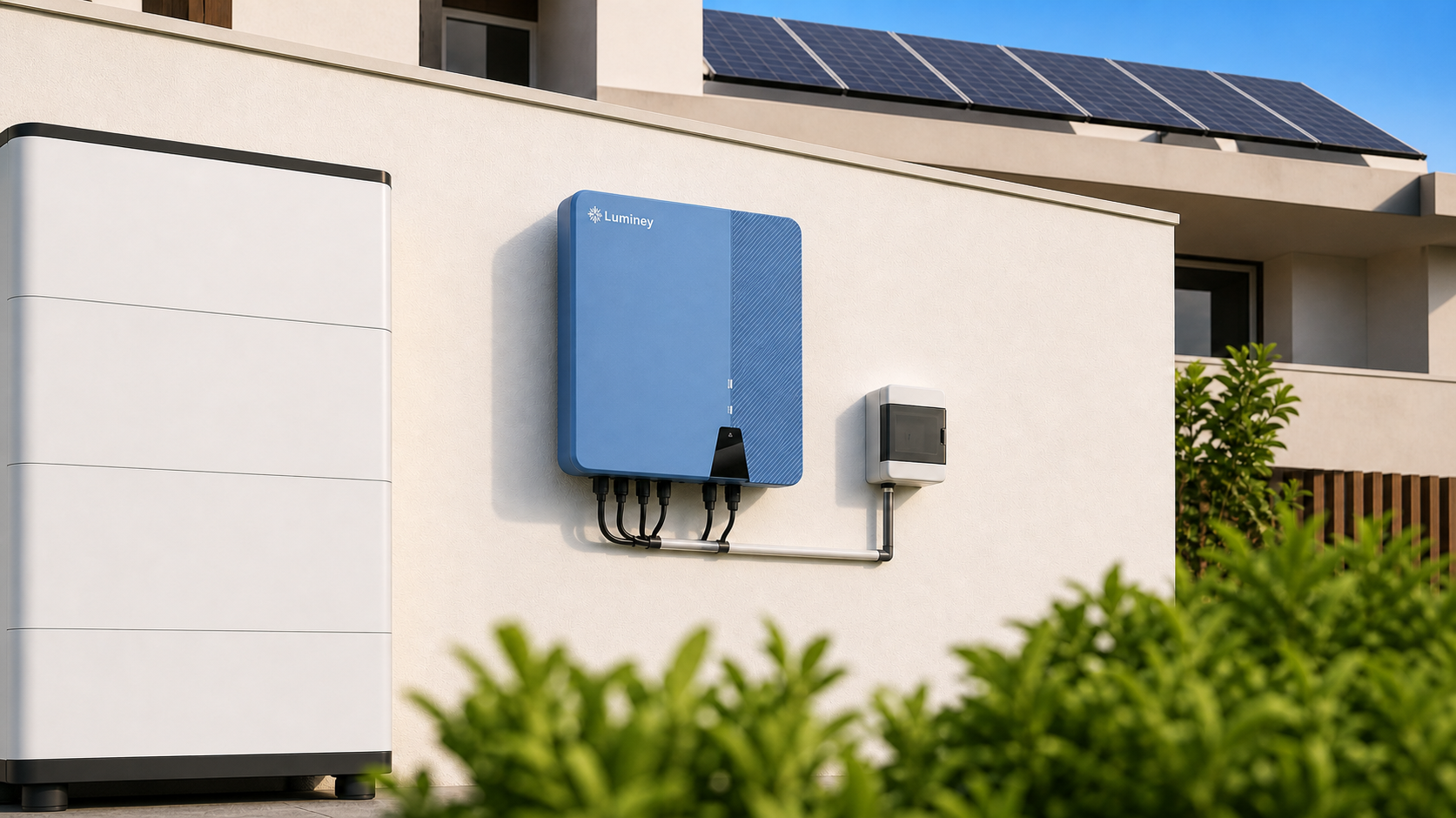
A complete 10kW solar system in Pakistan generally costs PKR 850,000 to PKR 2.8 million in 2026. An on-grid system without a battery usually sits near PKR 850,000 to PKR 1.4 million. A hybrid system with useful lithium storage commonly costs PKR 1.3 million to PKR 2.8 million, depending mainly on battery size and installation scope.
The lowest online price is rarely a complete comparison. One package may include only panels, inverter, and basic installation. Another may include a lithium battery, elevated structure, premium protection, monitoring, transport, civil work, prosumer paperwork, and after-sales service.
10kW Solar System Price in Pakistan Complete Guide 2026
Thr following should be consider when looking for market prices, outage backup, and what they are best for.
10kW Solar System Price in Pakistan 2026: Latest Cost
The following figures are market-planning ranges, not fixed Luminey quotations. Luminey reviewed public Pakistan price guides and packages in August 2026.
Typical 2026 prices for 10kW solar systems in Pakistan
10kW system type
Typical 2026 price
Outage backup
Best for
On-grid, without battery
PKR 850,000 to 1,400,000
No
Lowest-cost bill reduction where the grid is stable
Hybrid, battery-ready
PKR 1,050,000 to 1,450,000
No battery included
Buyers who want storage later
Hybrid with about 5kWh lithium
PKR 1,300,000 to 1,750,000
Essential loads for shorter outages
Homes with limited load shedding
Hybrid with about 10kWh lithium
PKR 1,550,000 to 2,200,000
Longer essential-load backup
Large homes and small offices
Hybrid with 15kWh to 20kWh lithium
PKR 1,900,000 to 2,800,000+
Heavier evening and outage use
Premium homes and businesses
Off-grid with a large battery bank
PKR 2,000,000 to 3,200,000+
Required
Remote sites without a dependable grid
Why Current Quotes Differ by more than One Million Rupees
A fair quotation should name every item and model. The final 10kW Solar System Cost in Pakistan (2026) changes with:
The panel brand, wattage, grade, cell type, and warranty
The on-grid or hybrid inverter model and phase configuration
Lithium battery chemistry, usable capacity, power limit, and warranty
Standard roof mounting or an elevated steel structure
Roof height, access, transport distance, and civil work
AC and DC cable brands, sizes, lengths, and connectors
Earthing, isolators, breakers, surge protection, and lightning protection
Monitoring hardware, commissioning, and after-sales support
Prosumer application, meter, sanctioned-load work, and documentation
Taxes, exchange-rate movement, inventory, and city
Ask for a line-by-line bill of materials. A very low quote may simply exclude the battery, meter work, elevated structure, protection devices, or installation services that another seller includes.
10kW Solar System Cost in Pakistan (2026): Component Breakdown
The table below helps a buyer understand where the money goes. Component ranges overlap, and installers bundle labour and materials differently, so do not add every maximum value together.
Component-level planning ranges for a 10kW solar system in Pakistan
Component
Plain-language job
Typical planning range
10kW to 11kW solar panel array
Makes electricity from sunlight
PKR 300,000 to 500,000
10kW on-grid inverter
Converts solar electricity for home and grid use
PKR 180,000 to 350,000
10kW hybrid inverter
Manages solar, grid, batteries, and backup circuits
PKR 350,000 to 600,000
Mounting structure
Holds panels safely above the roof
PKR 120,000 to 300,000
Cables and electrical protection
Connects and protects the complete system
PKR 90,000 to 200,000
Installation and commissioning
Builds, tests, and starts the system
PKR 80,000 to 180,000
About 5.12kWh lithium battery
Stores energy for essential backup
PKR 205,000 to 310,000
About 10kWh lithium storage
Provides longer or heavier backup
PKR 445,000 to 570,000
About 14kWh to 16kWh lithium storage
Supports larger evening and business loads
PKR 550,000 to 700,000+
Online package prices can exclude delivery, taxes, meter charges, building work, long cable runs, premium earthing, and an elevated structure. Written scope matters more than the headline figure.
What does 10kW mean in Simple Words?
10kW means the system can supply up to about 10,000 watts at one moment under its rated conditions. It does not mean the system produces 10 electricity units every hour from sunrise to sunset.
Think of power and energy like water:
kW is the width of the pipe. It tells you how many appliances can run together.
kWh is the water in the tank. It tells you how long appliances can keep running.
One electricity unit equals one kWh. A 1,000W appliance running for one hour uses one unit.
A 10kW inverter and a 10kWh battery describe different things. The inverter controls the maximum live load. The battery controls stored runtime.
Sellers also use "10kW system" in two ways. It may describe about 10kW of panel capacity, a 10kW inverter, or both. Ask the quotation to show DC panel capacity and AC inverter output separately so the package can be compared correctly.
How many Units does a 10kW Solar System produce in Pakistan?
A well-installed 10kW solar array can produce roughly 35 to 45 units per day, 1,050 to 1,350 units in an average month, and 12,500 to 16,000 units per year. Summer, winter, monsoon clouds, roof shade, heat, dust, orientation, and equipment downtime change actual output.
The World Bank's solar PV potential report places Pakistan among countries with excellent solar conditions, where average daily PV output can exceed 4.5kWh per installed kWp. A real roof produces less than a perfect calculation because every system has heat, wiring, inverter, dirt, and availability losses.
Practical energy output ranges for a 10kW solar system in Pakistan
Period
Practical 10kW planning range
What can lower it
Clear summer day
40 to 50 units
Extreme panel heat, dust, shade, clipping
Winter or cloudy day
20 to 35 units
Shorter days, fog, cloud, low sun angle
Average month
1,050 to 1,350 units
Monsoon, soiling, downtime, poor design
Full year
12,500 to 16,000 units
Location, maintenance, orientation, system losses
Use these figures for early planning only. A professional proposal should include a city-specific production estimate and a monthly generation table.
Is a 10kW System Right for your Electricity Bill?
A 10kW system is a strong starting point when a home or business uses roughly 900 to 1,400 units per month, especially when much of that electricity is consumed during the day. Do not size solar from the bill amount alone because tariffs, taxes, and seasonal use can distort the picture.
Review the last 12 electricity bills and note:
Total units used in every month
Daytime and nighttime load patterns
Summer AC consumption
Future appliances such as another AC, electric geyser, or EV charger
Loads that must work during an outage
A family using 1,200 units mostly at night may need more battery strategy than a shop using the same 1,200 units during sunny business hours.
How many Panels are Required for a 10kW Solar System?
Most modern 10kW systems use 16 to 19 solar panels. The exact count depends on each panel's wattage.
Panel count required for a 10kW solar array by panel wattage
Panel wattage
Panels required
Total panel capacity
550W
19
10.45kW
585W
18
10.53kW
600W
17
10.20kW
625W
16
10.00kW
650W
16
10.40kW
A slightly oversized panel array can improve morning and winter production when the inverter manufacturer permits it. The installer must still stay within the inverter's voltage, current, string, and total PV input limits.
Plan for roughly 600 to 800 square feet of clear roof space. Water tanks, parapet shadows, walking paths, panel tilt, row spacing, and future cleaning access can increase the required area.
What Appliances can a 10kW Solar System Run?
A 10kW system can run many household or small-business appliances together, but the safe answer depends on their real wattage and whether they start at the same time. AC compressors, pumps, refrigerators, and freezers can briefly demand extra startup power.
Typical Appliance Power in a Pakistani Home
Typical running power of common household appliances
Appliance
Typical running power
Simple planning note
LED bulb
8W to 15W
Fifteen bulbs use about 120W to 225W
Ceiling fan
50W to 90W
Ten fans use about 500W to 900W
Refrigerator
100W to 300W while running
Compressor startup needs extra power
Deep freezer
150W to 400W while running
Heat and thermostat setting matter
LED television
80W to 180W
Larger screens usually use more
Laptop or desktop
50W to 300W
Gaming computers use more
Washing machine
400W to 900W
A built-in heater uses much more
Water pump
750W to 1,500W
Startup surge may be several times higher
Electric iron
1,200W to 2,200W
High load, even when used briefly
Microwave
1,200W to 1,800W
Short use but high live demand
Electric kettle
1,500W to 2,200W
Avoid combining with other heavy loads
1.5-ton inverter AC
1,000W to 1,800W
Weather, room size, and setting matter
These are planning ranges. Read each appliance label or ask the installer to measure the actual load.
Example Daytime Home Load
This comfortable combination can stay below 10kW during good sunlight:
Two 1.5-ton inverter ACs: about 2,400W to 3,600W
Ten ceiling fans: about 500W to 900W
Fifteen LED lights: about 180W
One refrigerator and one freezer: about 400W to 700W while running
Two televisions, router, laptops, and chargers: about 400W to 700W
One washing machine: about 500W to 900W
One water pump: about 750W to 1,500W
Estimated running load: about 5.1kW to 8.5kW. Leave headroom for motor startup and changing AC demand. Avoid adding an iron, kettle, or microwave while the pump and washing machine are already running.
Can a 10kW Solar System run Three ACs?
Yes, three efficient inverter ACs can run during strong sunlight when their combined draw and the rest of the home remain below the inverter's continuous limit. Hot weather can push each AC closer to maximum power, so live measurement is safer than relying on a fixed appliance count.
Four 1.5-ton ACs may fit only under carefully measured conditions with light background load. Do not treat four ACs as a universal promise.
What a 10kW system can run in a small business
A 10kW system can suit a clinic, office, retail shop, school section, salon, workshop, or small cold-storage load when daytime demand is controlled.
Typical examples include:
Two or three inverter ACs plus lights, fans, computers, networking, and printers
A retail shop with lighting, signage, refrigeration, billing systems, and one or two ACs
A clinic with ACs, lights, computers, refrigeration, and basic equipment
A small office with 10 to 20 laptops, network equipment, lights, fans, and ACs
Large motors, welders, compressors, commercial ovens, electric heaters, lifts, and three-phase machinery need a separate engineering study. Their startup demand can be much higher than their normal running watts.
10kw Solar System Price in Pakistan without Battery
The 10kw solar system price in Pakistan without battery is approximately PKR 850,000 to PKR 1.4 million for on-grid and PKR 1.05 million to PKR 1.45 million for a battery-ready hybrid setup.
Choose on-grid when the priority is the lowest upfront cost and the grid is dependable. Choose battery-ready hybrid when outages matter or storage may be added later. Confirm that the selected hybrid inverter can operate safely without a battery and that future compatible batteries will remain available.
An on-grid inverter normally shuts down during a power outage for worker and grid safety. Solar panels on the roof do not automatically mean the home stays powered during load shedding.
10 kW Solar System with Battery Price in Pakistan
The 10 kW Solar System with Battery price in Pakistan depends more on stored energy than on the word "battery." A small 5kWh battery and a large 20kWh bank provide very different backup.
Battery storage sizes, practical backup duration, and complete-system prices
Battery storage
Practical AC energy
Example backup at 1kW
Example backup at 2kW
Typical complete-system price
About 5kWh
About 4.0 to 4.6kWh
4 to 4.5 hours
About 2 hours
PKR 1.3M to 1.75M
About 10kWh
About 8 to 9kWh
8 to 9 hours
4 to 4.5 hours
PKR 1.55M to 2.2M
About 15kWh
About 12 to 13.5kWh
12 to 13 hours
6 to 7 hours
PKR 1.9M to 2.5M
About 20kWh
About 16 to 18kWh
16 to 18 hours
8 to 9 hours
PKR 2.2M to 2.8M+
Backup estimates allow for normal battery settings and inverter losses. Real runtime changes with temperature, battery age, depth-of-discharge settings, conversion efficiency, and changing appliance loads.
10kW Solar System with Lithium Battery Price in Pakistan
The 10kW solar system with lithium battery price in Pakistan commonly starts near PKR 1.3 million with about 5kWh storage and can exceed PKR 2.8 million with 20kWh storage, premium equipment, and a complex installation.
LiFePO4 is a common lithium chemistry for home storage because it is designed for frequent cycling and stable operation. Compare these details before comparing price:
Usable kWh, not only nominal kWh
Continuous and short-duration output power
Battery management system protection
Approved inverter communication and compatibility
Indoor or outdoor protection rating
Cycle-life conditions and warranty terms
Local claim process, replacement time, and technical support
A large battery does not guarantee that every appliance can run together. The battery and inverter must both support the live load.
10kW Hybrid Solar System Price in Pakistan
The 10kW hybrid solar system price in Pakistan is approximately PKR 1.05 million to PKR 1.45 million without a battery and PKR 1.3 million to PKR 2.8 million with lithium storage.
A hybrid system combines three power sources:
Solar panels supply daytime loads.
A battery stores energy for outages or evening use.
The grid supports the home when solar and battery power are insufficient.
Hybrid is usually the most flexible choice for a home with load shedding. It also costs more and requires careful compatibility between the inverter, battery, backup circuits, protection, and software settings.
On-Grid vs Hybrid vs Off-Grid 10kW Solar
On-grid, hybrid, and off-grid solar systems compared feature by feature
Feature
On-grid
Hybrid
Off-grid
Connected to utility grid
Yes
Yes in normal use
Not required
Battery needed
No
Optional or included
Yes
Works during outage
No
Yes, with supported backup
Yes
Upfront price
Lowest
Medium to high
Highest
Best for
Daytime savings
Savings plus backup
Remote or highly unreliable locations
Main tradeoff
No load-shedding power
Higher cost and more design choices
Large battery bank and strict energy management
Choose on-grid for the fastest financial return where the grid is stable. Choose hybrid when power continuity matters. Choose off-grid only after sizing enough winter generation and battery reserve for days with weak sunlight.
10 kw Solar System Price in Pakistan with Net Metering
The 10 kw solar system price in pakistan with net metering is commonly PKR 900,000 to PKR 1.5 million, depending on whether the quote includes the bidirectional meter, application support, sanctioned-load changes, protection, and all distribution-company charges.
Pakistan's NEPRA Prosumer Regulations 2026 introduced net billing for new prosumer arrangements. Imported electricity is billed at the applicable retail tariff. Exported electricity is credited at the national average energy purchase price determined under the regulations.
This means one exported unit does not necessarily cancel one imported unit at the same rupee value. Using solar directly during the day is usually more valuable than exporting unnecessary surplus. Run ACs, water pumps, washing machines, and other flexible loads during solar hours where practical.
The 2026 regulations also state that a proposed distributed-generation system cannot exceed the premises' sanctioned load. A new 10kW prosumer application therefore needs at least 10kW of sanctioned load unless the rule changes. Confirm phase, transformer capacity, documentation, meter availability, and current rates with the relevant DISCO or K-Electric before paying.
Do not assume solar will remove every bill. Nighttime imports, fixed charges, taxes, low export credit, seasonal production, and system downtime can leave a payable amount.
Savings and Payback for a 10kW System
The financial value of solar now depends heavily on how much electricity is used while the sun is shining.
Simple On-Grid Example
Assume:
Complete installed price: PKR 1,100,000
Annual solar generation: 14,000 units
Daytime self-use: 70%, or 9,800 units
Avoided grid energy value: PKR 50 per unit
Exported energy: 4,200 units
Illustrative export credit: PKR 10 per unit
Calculation:
Self-use value: 9,800 x PKR 50 = PKR 490,000 per year
Export value: 4,200 x PKR 10 = PKR 42,000 per year
Total illustrative annual value: PKR 532,000
Simple payback: PKR 1,100,000 divided by PKR 532,000 = about 2.1 years
The PKR 50 and PKR 10 values are examples, not tariff claims. Replace them with the effective import rate on the latest bill and the export rate applicable to the actual agreement.
A cautious planning range is about 2.5 to 5 years for on-grid and 4 to 8 years for battery-backed hybrid. Batteries add backup and comfort, but their cost usually extends financial payback.
Annual solar value = self-used units x avoided grid rate + exported units x export credit
Simple payback = complete installed price divided by annual solar value
This calculation excludes financing cost, maintenance, battery replacement, degradation, taxes, fixed charges, and downtime.
What makes Luminey Different for a 10kW Solar Plan?
Luminey focuses on the two components that decide how solar power is converted, monitored, and stored: the inverter and energy-storage system.
For an on-grid 10kW plan, the Luminey G2 Pro is published in 10kW, 15kW, and 20kW sizes. Luminey lists 150% PV oversizing support, suitability for bifacial modules, ShadeSol management, easy setup, and app monitoring for the G2 Pro range.
For battery storage, Luminey's published residential choices include:
SunESS H: 5kWh, 10kWh, 15kWh, and 20kWh options using LiFePO4 technology, built-in protection, a built-in display, and support for grid-tied and off-grid applications
Monawall: IP65 water and dust protection, built-in Wi-Fi, 1C discharge, 100% depth of discharge, and 6,000 published life cycles
Atrix: Flexible application, simple installation, optional battery-app support, and 0.5C or 1C charging and discharging
The practical difference from many anonymous packages is not a broad "best" claim. Luminey publishes model-level features, compatibility information, monitoring options, and a support route. Luminey also states that customer-care centers operate across Pakistan and that its team assists customers with product understanding and installation.
Product matching still matters. The G2 Pro is an on-grid inverter and should not be presented as a battery-backup inverter. A hybrid design needs a compatible hybrid inverter, battery voltage, communication protocol, protection system, and approved operating settings.
The following checks make different 10KW Solar System Price in Pakistan quotations easier to compare fairly.
Use this checklist before paying an advance:
Share 12 months of bills. Size the system from units and usage patterns, not one summer bill.
Separate daytime and nighttime loads. Net billing makes daytime self-use especially valuable.
List must-run outage appliances. Battery sizing should begin with these loads.
Measure ACs, pumps, and motors. Nameplate and live demand can differ.
Confirm panel authenticity. Record the exact brand, model, wattage, grade, serial numbers, and warranty.
Confirm inverter type and phase. On-grid and hybrid inverters perform different jobs.
Check battery compatibility. Match voltage, communication, continuous power, firmware, and approved models.
Demand protection details. The quotation should name cable sizes, breakers, isolators, surge protection, earthing, and connectors.
Inspect the roof design. Check shade, wind exposure, waterproofing, structure height, access, and cleaning paths.
Confirm prosumer scope. Ask who handles sanctioned load, drawings, application, meter, inspections, and fees.
Read every warranty. Confirm parts, labour, transport, exclusions, claim location, and expected turnaround.
Model a realistic payback. Use current import and export values and include fixed charges.
The cheapest package is not automatically the lowest-cost system to own. Safe installation, compatible equipment, transparent warranty support, and accurate design protect the investment for years.
Future-Proofing a 10kW System
Buy for the next five years, not only today's bill. Ask whether the design can support:
A second battery module
Another inverter AC
An electric vehicle charger
Smart scheduling of pumps and appliances
Essential-load and non-essential-load separation
Generator coordination where supported
Remote monitoring and fault alerts
Higher daytime business use
Panel expansion is not always simple. The roof may run out of space, the inverter may reach its input limit, and a larger prosumer system may require more sanctioned load. Plan those constraints before installation.
Frequently Asked Questions
What is the 10kW solar system price in Pakistan?
A complete 10kW system generally costs PKR 850,000 to PKR 2.8 million in
Pakistan during 2026. On-grid systems sit near the lower end. Hybrid and
off-grid systems with larger lithium batteries, premium structures,
protection, and installation sit near the upper end.
What is the 10kW solar system price in Pakistan 2026?
The practical 2026 range is PKR 850,000 to PKR 1.4 million for on-grid
and PKR 1.3 million to PKR 2.8 million for hybrid with lithium storage.
Exact cost depends on battery size, inverter model, structure,
protection, installation, and paperwork.
What is the 10kW solar system price in Pakistan without battery?
The 10kW solar system price in Pakistan without battery is about PKR
850,000 to PKR 1.4 million for on-grid. A battery-ready hybrid system
usually costs PKR 1.05 million to PKR 1.45 million before storage is
added.
What is the 10kW solar system price in Pakistan with net metering?
A 10kW package with prosumer application support generally costs PKR
900,000 to PKR 1.5 million. Confirm whether the quote includes the
meter, sanctioned-load work, drawings, protection, inspections, fees,
and installation because sellers package these costs differently.
What is the 10kW solar system with battery price in Pakistan?
A complete battery-backed 10kW system generally costs PKR 1.3 million to
PKR 2.8 million. About 5kWh storage sits near the lower end, while 15kWh
to 20kWh storage, premium equipment, and complex structures move the
price upward.
What is the 10kW solar system with lithium battery price in Pakistan?
A 10kW solar system with lithium storage starts near PKR 1.3 million
with about 5kWh capacity. A system with 10kWh commonly costs PKR 1.55
million to PKR 2.2 million, while 20kWh packages can exceed PKR 2.8
million.
What is the 10kW hybrid solar system price in Pakistan?
A 10kW hybrid solar system costs about PKR 1.05 million to PKR 1.45
million without a battery. With lithium storage, a complete system
generally costs PKR 1.3 million to PKR 2.8 million, depending on battery
capacity and installation quality.
How many units does a 10kW solar system produce in Pakistan?
A well-installed 10kW solar system can produce roughly 35 to 45 units
daily, 1,050 to 1,350 units monthly, and 12,500 to 16,000 units
annually. City, season, shade, dust, heat, panel direction, design, and
downtime change actual generation.
How many ACs can a 10kW solar system run?
A 10kW system can usually run two or three efficient 1.5-ton inverter
ACs with normal home loads during strong sunlight. Four ACs require
careful measurement and light background demand. Night operation depends
on battery energy, output power, and AC consumption.
Can a 10kW system run an AC at night?
Yes, but nighttime AC use requires a hybrid inverter and sufficient
battery storage. A 10kWh lithium battery may provide about eight to nine
usable units, so one efficient AC plus essential loads could run for
several hours, depending on weather and settings.
What battery size is best for a 10kW system?
Choose about 5kWh for short essential backup, 10kWh for longer household
backup, and 15kWh to 20kWh for heavier evening loads. The correct size
comes from required appliances, outage duration, live power, battery
output limits, and available charging energy.
How many panels and how much roof space are needed?
Most modern 10kW systems use 16 to 19 panels and need roughly 600 to 800
square feet of clear roof. Panel wattage, tilt, row gaps, shadows,
tanks, parapets, access paths, and structure type determine the final
count and layout.
Is on-grid or hybrid better for a 10kW system?
On-grid is better for the lowest price and daytime savings where the
grid is stable. Hybrid is better when load shedding, evening use, or
battery expansion matters. The right choice depends on outage frequency,
self-consumption, backup expectations, and budget.
Is a 10kW solar system suitable for a business?
Yes. A 10kW system can suit an office, clinic, school section, retail
shop, salon, or small workshop with controlled daytime demand. Large
motors, welders, compressors, heaters, lifts, refrigeration plants, and
industrial machinery require separate engineering and startup-load
checks.
What is the payback period for a 10kW system?
A carefully sized on-grid system may recover its cost in roughly 2.5 to
5 years. A battery-backed hybrid system often needs 4 to 8 years because
storage adds cost. Tariffs, self-use, export credit, financing,
downtime, and maintenance affect payback.
Does an on-grid 10kW system work during load shedding?
No. A standard on-grid inverter shuts down during an outage to protect
utility workers and the network. Outage backup requires a supported
hybrid or backup system, correctly separated essential-load circuits,
sufficient battery energy, and properly installed safety equipment.
Can I add a battery to my 10kW system later?
Yes, if the original design uses a battery-ready hybrid inverter or
allows a separate compatible storage solution. Confirm voltage,
communication, firmware, power limits, protection, and approved battery
models before purchase. A standard on-grid inverter does not directly
accept a battery.
Can a 10kW system charge an electric vehicle?
Yes, a 10kW system can support daytime EV charging when household or
business loads leave enough spare solar power. Charger rating, car
battery size, phase, charging schedule, sanctioned load, export rules,
and future panel or storage expansion should be planned together.
How often should 10kW solar panels be cleaned?
Cleaning frequency depends on dust, rain, birds, traffic pollution, and
roof safety. Inspect generation regularly and clean when dirt causes a
visible drop. Use safe access, clean water, and manufacturer-approved
methods. Avoid walking on panels or cleaning hot glass suddenly.
Does a 10kW prosumer system require 10kW sanctioned load?
Under the NEPRA Prosumer Regulations 2026, proposed generation capacity
cannot exceed the premises' sanctioned load. A new 10kW application
therefore needs at least 10kW sanctioned load unless regulations change.
Confirm current requirements with the relevant utility before
installation.