Lithium Battery Price in Pakistan 2026: Sizes, Backup and Buying Guide
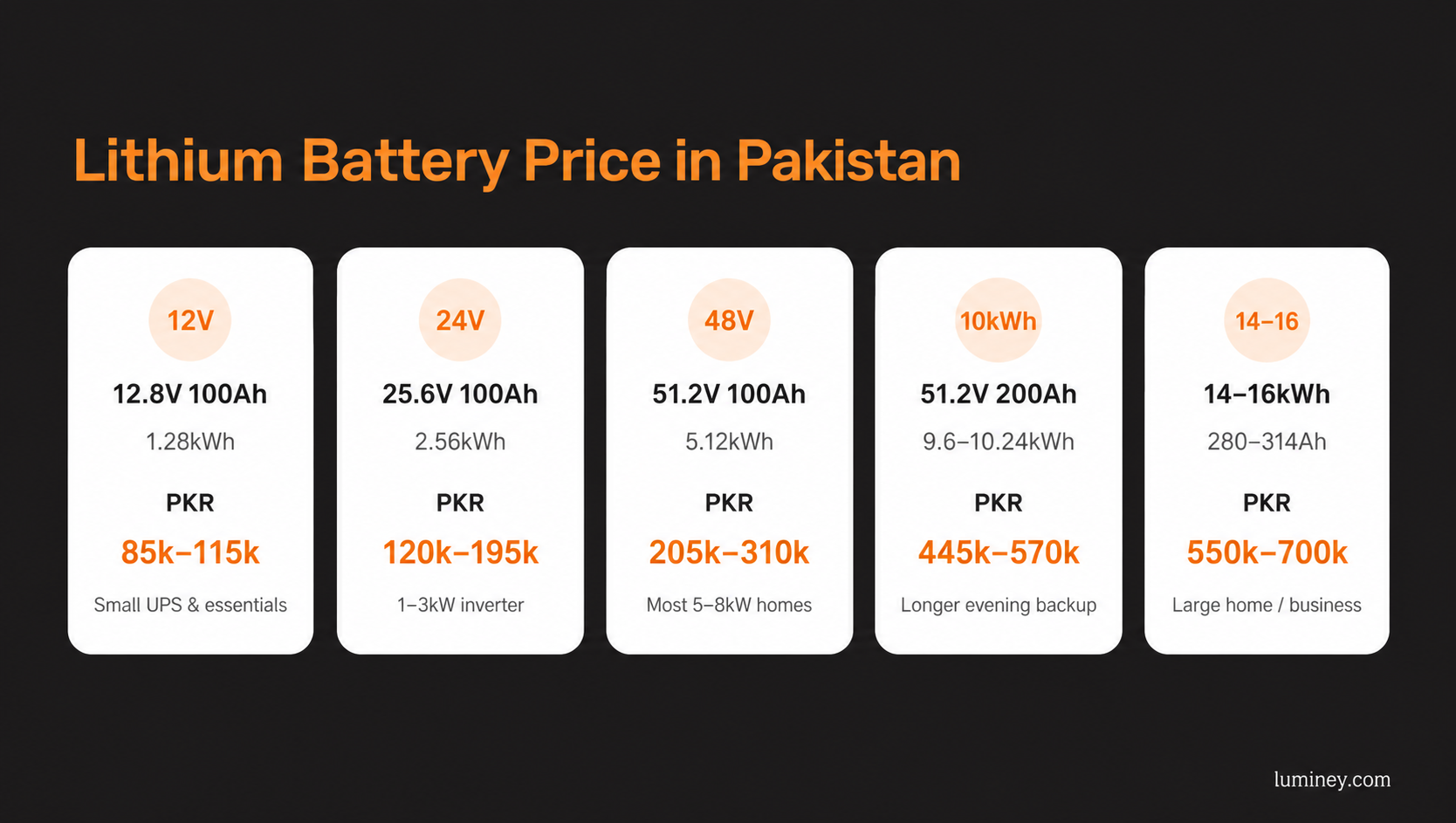
In July 2026, lithium battery prices in Pakistan generally run from PKR 85,000 for a 12.8V 100Ah LiFePO4 battery to PKR 700,000 for a 14–16kWh system. Most homes choose a 51.2V 100Ah, 5.12kWh battery costing PKR 205,000–310,000. Brand, warranty, BMS, IP rating and inverter compatibility change the final quote.
Best Lithium Ion Battery in Pakistan 2026
The table below compares batteries by stored energy in kilowatt-hours (kWh). This makes prices easier to compare than amp-hours alone.
Battery size, nameplate energy, typical July 2026 price, and suitable use
Battery size
Nameplate energy
Typical July 2026 price
Suitable for
12.8V 100Ah LiFePO4
1.28kWh
PKR 85,000–115,000
Small UPS, lights, fans, router
25.6V 100Ah LiFePO4
2.56kWh
PKR 120,000–195,000
1–3kW inverter, essential home loads
48V/51.2V 100Ah LiFePO4
4.8–5.12kWh
PKR 205,000–310,000
Most 5–8kW hybrid home systems
48V/51.2V 200Ah LiFePO4
9.6–10.24kWh
PKR 445,000–570,000
Longer backup, one AC plus essentials
51.2V 280–314Ah LiFePO4
14.3–16.1kWh
PKR 550,000–700,000
Large homes and small businesses
12V 200Ah tubular lead-acid
2.4kWh nameplate
PKR 44,000–85,000 each
Lower upfront budget; regular maintenance
Important: Sellers often use “48V battery” as a category name. Many modern LiFePO4 products are actually 51.2V nominal, created from 16 cells in series. Always follow the inverter manufacturer’s approved voltage range and compatibility list.
How We Calculated These Price Ranges
Luminey reviewed visible asking prices and published ranges from Pakistani retailers, distributors and market guides between 7 and 15 July 2026. We compared matching voltage and capacity, removed unavailable or unclear listings, and rounded the remaining range for easier budgeting.
The review included CoreTECH Solar, CNC Electric Pakistan, Hybrid EV Engineering, MM News, Mega Godam and current tubular-battery price sources.
Limitations: Online prices may exclude delivery, installation, DC protection, taxes or promotional conditions. A low price can also reflect a shorter warranty, different cell quality or limited after-sales support. Request a written quotation before buying.
Why Battery Pricing Matters Now
Pakistan’s battery-storage market is expanding quickly. IEEFA estimates that Pakistan imported about 1.25GWh of lithium-ion battery packs in 2024 and another 400MWh in the first two months of 2025. More buyer choice makes like-for-like comparison and reliable after-sales supportwhich is more important.
What do volts, amp-hours and kWh mean?
You only need three simple ideas:
Volts (V) must match the inverter’s battery system. A 24V battery cannot be connected directly to a 48V inverter.
Amp-hours (Ah) describe electrical charge, but Ah cannot show total energy without voltage.
Kilowatt-hours (kWh) show stored energy and are the best unit for comparing backup capacity.
Use this formula:
Battery energy (kWh) = voltage × amp-hours ÷ 1,000
Examples:
12.8V × 100Ah ÷ 1,000 = 1.28kWh
25.6V × 100Ah ÷ 1,000 = 2.56kWh
51.2V × 100Ah ÷ 1,000 = 5.12kWh
This is why the phrase “100 amp lithium battery” is incomplete. Pakistani buyers usually mean 100Ah, but a 12V 100Ah battery stores only one-quarter of the energy of a 51.2V 100Ah battery.
Lithium Battery Price in Pakistan 12V
A 12.8V 100Ah LiFePO4 battery generally costs PKR 85,000–115,000 in July 2026. Its 1.28kWh nameplate capacity suits a small UPS, telecommunications equipment, lights, fans and a router. It is not the normal choice for a 5kW home solar inverter.
Lithium Battery Price in Pakistan 24V
A 25.6V 100Ah lithium battery generally costs PKR 120,000–195,000. Its 2.56kWh capacity is useful with 1–3kW inverters and medium essential loads. Confirm the continuous discharge current before expecting the lithium battery 24v price in pakistan to run pumps, irons or air conditioners.
Lithium Battery Price in Pakistan 48V
A 48V or 51.2V 100Ah lithium battery generally costs PKR 205,000–310,000. This 4.8–5.12kWh category is Pakistan’s mainstream choice for 5–8kW hybrid inverters because higher voltage reduces current for the same power.
Lithium Battery Price in Pakistan 100 amp
For a “100 amp” battery, first ask the seller for its voltage. Current 100Ah ranges are approximately PKR 85,000–115,000 at 12.8V, PKR 120,000–195,000 at 25.6V, and PKR 205,000–310,000 at 48V/51.2V.
Which Lithium Battery is Best in Pakistan?
For most Pakistani solar homes, the best technical starting point is a 51.2V LiFePO4 battery with documented inverter communication, an appropriate IP rating and a locally enforceable warranty. The best product is the one that safely supports the required load and integrates with the existing inverter, not simply the cheapest battery.
Use this decision table:
Buyer needs, best-fit specifications, and why each specification matters
Buyer need
Best-fit specification
Why it matters
5–8kW home solar
51.2V, 100Ah, about 5.12kWh
Common residential size and manageable starting cost
Longer evening backup
51.2V, 200Ah, about 10.24kWh
Roughly doubles stored energy
Indoor modular expansion
Stackable/rack battery with CAN or RS485
Easier to add capacity when the system supports it
Atrix is designed for modular expansion and is listed as scalable up to 120kWh.
Monawall provides an IP65 weather-resistant enclosure and is listed as scalable up to 80kWh.
SunESS H is offered in 5kWh, 10kWh, 15kWh and 20kWh sizes.
Ask Luminey to confirm the current datasheet, battery chemistry, usable capacity, inverter compatibility, warranty conditions and installed price for your location.
LiFePO4 vs lithium-ion: which chemistry should you buy?
LiFePO4 is a type of lithium-ion battery. “Lithium-ion” is the larger family; lithium iron phosphate (LFP or LiFePO4) is the chemistry commonly selected for stationary solar storage because it prioritizes thermal stability and cycle life over compact size.
Comparison of LiFePO4, NMC/NCA lithium-ion, and tubular lead-acid batteries
Feature
LiFePO4 (LFP)
NMC/NCA lithium-ion
Tubular lead-acid
Typical use
Solar and stationary backup
EVs and portable devices
UPS and budget solar backup
Usable depth
Often 80–90%, model-dependent
Model-dependent
Commonly kept near 50% for longer life
Maintenance
Low
Low
Water and terminal checks may be needed
Communication
Smart BMS, often CAN/RS485
Smart BMS
Usually no smart communication
Weight
Lower than equivalent lead-acid bank
Low
High
Buying priority
Safety, BMS, cycle terms, compatibility
Thermal management and BMS
Ventilation, maintenance and replacement cost
A representative Dyness 5.12kWh LiFePO4 datasheet specifies 90% depth of discharge and at least 6,000 cycles under stated laboratory conditions. Those figures are product-specific, not promises for every lithium battery.
How Much Backup will a 5.12kWh Lithium Battery Provide?
A sensible household estimate uses about 80% of nameplate energy at the AC socket after allowing for reserve, conversion losses and real-world conditions.
The NREL Storage Futures Study reports lithium-ion round-trip efficiency near 86% in its technology comparison. Luminey uses a lower 80% factor here as a simple planning allowance, not a product guarantee.
Average running load, approximate backup from 5.12kWh, and everyday examples
Average running load
Approximate backup from 5.12kWh
Everyday example
500W
8.2 hours
Fans, lights, fridge and internet
1,000W
4.1 hours
Essentials plus television or computer
1,500W
2.7 hours
Essentials plus a moderate additional load
2,000W
2.0 hours
High combined household load
These are planning estimates, not guarantees. Fridge and AC compressors cycle on and off; motor startup power, temperature, battery age, inverter efficiency and the BMS limit can change actual backup.
How to Size a Lithium Battery for your Home
Step 1: Add the watts of loads used together
Do not add every appliance in the house. Add only the items that must run during the same outage period.
Step 2: Multiply the average load by backup hours
If essential loads average 750W for four hours:
0.75kW × 4 hours = 3kWh required at the AC side
Step 3: Add a practical reserve
Divide the required AC energy by 0.80:
3kWh ÷ 0.80 = 3.75kWh minimum nameplate capacity
The next common size is 5.12kWh, so a 51.2V 100Ah battery is a practical fit.
Step 4: Check power, not only energy
A battery may store enough kWh yet still be unable to start or continuously run a heavy load. Confirm the battery’s continuous discharge current, peak current, BMS limit and inverter surge requirement.
Step 5: Confirm inverter communication
Ask for the exact inverter model and firmware on the battery compatibility list. CAN or RS485 communication lets the inverter read state of charge and apply the correct charge and discharge limits.
Simple Cost Analysis: Lithium vs Tubular Battery
The battery with the lowest purchase price is not always the lowest-cost battery. Compare usable kWh, expected cycles, replacements, maintenance, protection and warranty, not only rupees on the invoice.
Upfront Comparison for about 2.3–2.4kWh Usable Storage
Comparison of LiFePO4 and tubular battery configurations, usable energy, and July 2026 cost
Option
Example configuration
Approx. usable energy
July 2026 battery cost
LiFePO4
One 25.6V 100Ah battery at 90% DoD
2.30kWh
PKR 120,000–195,000
Tubular
Two 12V 200Ah batteries in series at 50% DoD
2.40kWh
PKR 88,000–170,000 per bank
The tubular bank can cost less at the start. Lithium can become cheaper over its service life if it delivers more cycles and avoids multiple replacements. Actual results depend on temperature, discharge depth, charging settings and warranty coverage.
A Transparent Lifetime-Cost Example
Assume a 5.12kWh LFP battery costs PKR 240,000, allows 90% depth of discharge and reaches 6,000 cycles under the manufacturer’s test conditions:
Usable energy per full cycle: 5.12 × 0.90 = 4.61kWh
Battery purchase cost per theoretical kWh-cycle: 240,000 ÷ 27,648 = PKR 8.68
This number is a comparison tool, not a promised electricity cost. It excludes inverter losses, solar generation cost, finance, installation and future degradation. A 6,000-cycle datasheet rating may also use controlled 25°C testing that differs from a hot installation in Pakistan.
Do Batteries Reduce the Electricity Bill?
A battery does not generate electricity. A battery creates value by storing low-cost solar energy for evening use, reducing peak-grid purchases and providing backup during outages. The economic result depends on solar production, household load timing, tariffs and how often the battery cycles.
An IEEFA study on Pakistan estimated a 3–5 year payback for complete residential solar-plus-battery systems under its assumptions. That finding applies to the combined system, not to a battery purchased by itself.
Hidden Costs to include in the Quotation
Budget beyond the battery sticker price:
Battery-rated DC breaker or fuse
DC isolator where required
Correct cable size, lugs and enclosure
Surge protection where specified by the design
Rack, wall bracket or floor base
Labour, transport and commissioning
Firmware setup and communication cable
Earthing, ventilation and fire-safety provisions
One June 2026 market example added approximately PKR 23,300 for protection and cabling on a 10kWh installation before labour. The correct amount depends on cable length, current, installation method and local conditions.
Ten Checks Before Buying a Lithium Battery
Match voltage: The battery voltage must suit the exact inverter model.
Compare kWh: Convert voltage and Ah into energy before comparing prices.
Check usable capacity: Ask for depth of discharge and remaining-capacity warranty terms.
Verify discharge power: Confirm continuous and peak current for heavy loads.
Demand compatibility evidence: Get the inverter-battery protocol or compatibility list in writing.
Read the warranty: Check years, cycle limits, throughput limits, exclusions and claim location.
Confirm IP rating: IP20 is normally indoor; exposed locations need an approved enclosure or higher rating.
Inspect safety documents: Ask for applicable IEC, UN transport and product test documentation.
Price the full installation: Include protection, cables, labour, transport and commissioning.
Verify local support: Know who diagnoses faults, stocks parts and approves warranty claims in Pakistan.
Red Flags That can Turn a Cheap Battery into an Expensive Mistake
The seller quotes Ah without voltage or kWh.
The inverter model is “probably compatible” but no document is provided.
The battery has no serial-number verification or written warranty.
Cycle life is advertised without test temperature, depth of discharge or end-of-life capacity.
The installation uses undersized cable or omits battery-rated DC protection.
An indoor battery is installed in rain, direct sun or a sealed hot cabinet.
Multiple old and new batteries are mixed without manufacturer approval.
Solar Battery Price in Pakistan 2026: Lithium and Tubular Rates
Choose tubular when the budget is strict, maintenance is acceptable and occasional backup is the goal. Choose LiFePO4 when frequent cycling, deeper usable storage, lighter weight and smart inverter integration justify the higher starting price.
Comparison of battery categories, typical 2026 prices, advantages, and trade-offs
Battery category
Typical 2026 price
Main advantage
Main trade-off
12V 200Ah tubular
PKR 44,000–85,000 each
Lower upfront cost and wide availability
Heavy, maintenance and lower usable depth
24V 100Ah LiFePO4
PKR 120,000–195,000
Compact, deeper usable capacity
Higher initial cost
51.2V 100Ah LiFePO4
PKR 205,000–310,000
Good fit for mainstream hybrid homes
Compatibility must be verified
51.2V 200Ah LiFePO4
PKR 445,000–570,000
Longer backup and fewer parallel units
Larger investment
Get the Right Battery Quote from Luminey
For a useful quotation, send Luminey four details:
Inverter brand, model and rated power
Essential appliances and their wattage
Required backup hours
Installation location: indoor, outdoor or partly exposed
What is the lithium battery price in Pakistan in 2026?
Lithium battery prices in Pakistan range from about PKR 85,000 for 12.8V 100Ah models to PKR 700,000 for 14–16kWh systems in July 2026. A mainstream 51.2V 100Ah, 5.12kWh home battery typically costs PKR 205,000–310,000 before installation.
What is the lithium battery price in Pakistan in July 2026?
July 2026 market ranges are PKR 85,000–115,000 for 12.8V 100Ah, PKR 120,000–195,000 for 25.6V 100Ah, and PKR 205,000–310,000 for 48V/51.2V 100Ah. Dealer stock, exchange rates, warranty and installation scope can change the final price.
What is the 12V lithium battery price in Pakistan?
A 12.8V 100Ah LiFePO4 battery usually costs PKR 85,000–115,000 in July 2026. It stores 1.28kWh and suits small UPS systems, lights, fans and networking equipment. Check continuous current before connecting high-power appliances.
What is the 24V lithium battery price in Pakistan?
A 25.6V 100Ah LiFePO4 battery generally costs PKR 120,000–195,000 in July 2026. The battery stores 2.56kWh and commonly serves 1–3kW inverters. The inverter voltage and approved battery protocol must match before installation.
What is the 48V lithium battery price in Pakistan?
A 48V or 51.2V 100Ah lithium battery generally costs PKR 205,000–310,000 in July 2026. The category stores about 4.8–5.12kWh and is widely used with 5–8kW hybrid solar inverters in Pakistani homes.
What is the 100 amp lithium battery price in Pakistan?
“100 amp” usually means 100Ah, but price depends on voltage. July 2026 ranges are approximately PKR 85,000–115,000 at 12.8V, PKR 120,000–195,000 at 25.6V, and PKR 205,000–310,000 at 48V or 51.2V.
Which lithium battery is best for solar in Pakistan?
For most homes, a 51.2V LiFePO4 battery with documented inverter communication, suitable discharge power, local warranty support and the correct IP rating is the safest starting point. Required backup, inverter model and installation location determine the best capacity.
Is LiFePO4 different from lithium-ion?
LiFePO4 is one member of the lithium-ion battery family. LiFePO4 prioritizes thermal stability and long cycle life, making it popular for stationary solar storage. NMC and NCA lithium-ion chemistries offer higher energy density and are common in vehicles and portable electronics.
How much energy does a 51.2V 100Ah battery store?
A 51.2V 100Ah battery stores 5.12kWh of nameplate energy because 51.2 × 100 ÷ 1,000 equals 5.12. Real AC energy is lower after reserve, battery limits and inverter losses; about 80% is a sensible planning assumption.
How long can a 5.12kWh lithium battery run a home?
Using an 80% planning factor, a 5.12kWh battery provides about 8.2 hours at 500W, 4.1 hours at 1,000W or 2 hours at 2,000W. Actual backup changes with appliance cycling, temperature, inverter losses and battery condition.
Can a 5.12kWh battery run an air conditioner?
A 5.12kWh battery can run a compatible inverter AC if the battery and inverter support the required continuous and startup power. Backup may be short once other loads are added. A measured load audit is better than sizing from AC tonnage alone.
Can I use a lithium battery with my existing inverter?
Only if the inverter supports the battery voltage, chemistry, charging limits and communication method. Ask for written compatibility for the exact inverter model and firmware. An installer may use manual voltage settings only when both manufacturers explicitly allow that configuration.
How long does a lithium solar battery last?
Service life depends on cell chemistry, temperature, discharge depth, charge rate and operating limits. Some LiFePO4 models specify at least 6,000 cycles under controlled test conditions. The written warranty, throughput limit and remaining-capacity guarantee matter more than an isolated cycle claim.
Is a tubular battery cheaper than lithium?
A tubular battery usually costs less upfront. Two 12V 200Ah tubular batteries can provide roughly the usable energy of one 25.6V 100Ah LiFePO4 battery, but the bank is heavier, needs more care and may require replacement sooner under frequent cycling.
What should a lithium battery warranty include?
A useful warranty states years, cycle or energy-throughput limits, minimum retained capacity, temperature and installation requirements, compatible inverter conditions, exclusions and the Pakistan claim process. Confirm who pays transport and labour and which service centre approves a replacement.

.png)