
October 22, 2026
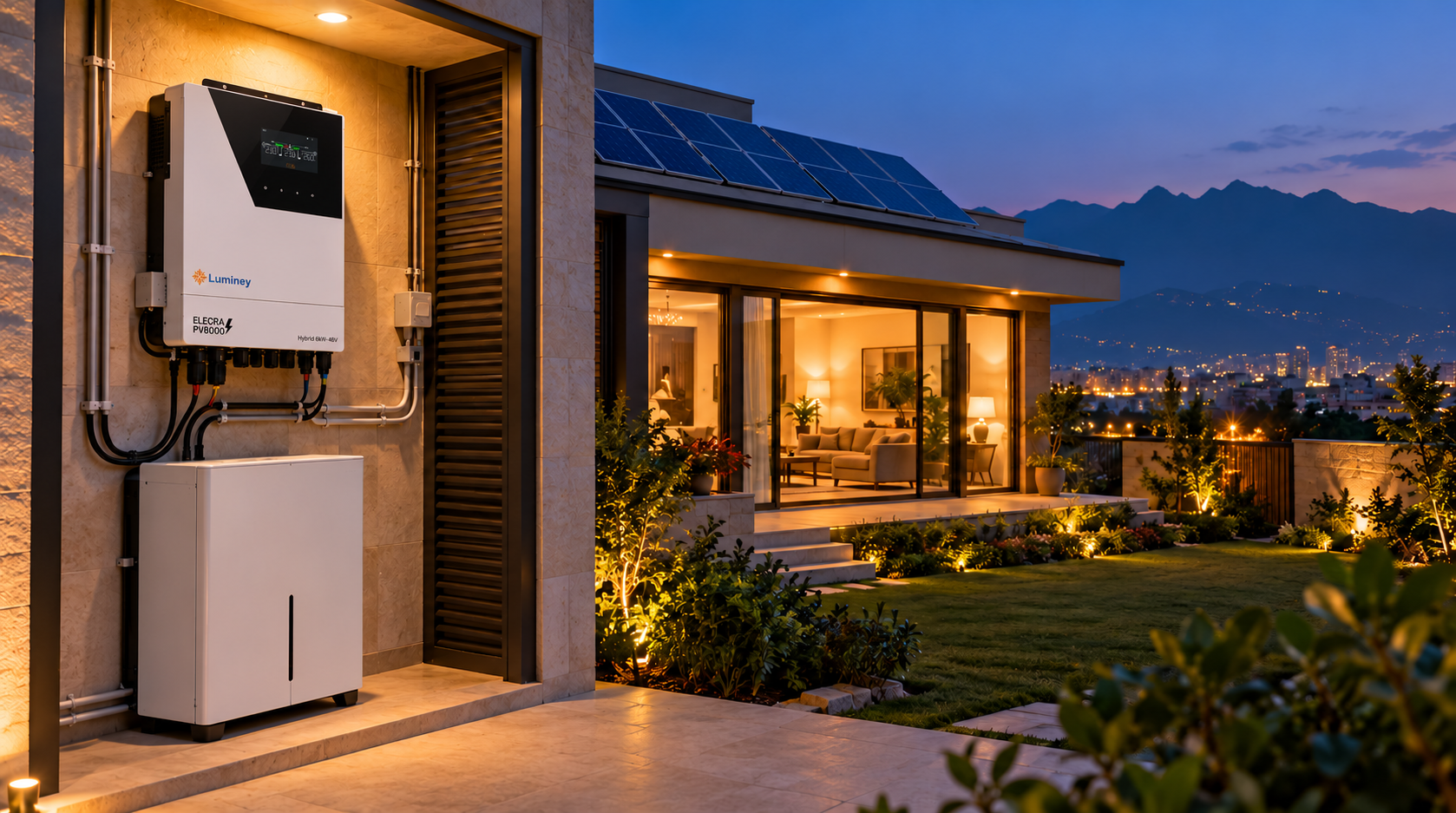
Luminey's Elecra PV8000 is a useful starting point when comparing the 6kW hybrid inverter price in Pakistan. Its rated output is 6.2kW, so it belongs in the nearby home-backup comparison rather than being described as an exact 6kW model.
More importantly, a price comparison should establish what the inverter can power, which battery it supports and what the quoted amount includes.
This guide helps homeowners compare advertised inverter prices, size essential loads and plan the rest of a solar-plus-storage installation. The same checks are useful for a small office or shop, while larger commercial and industrial projects need a broader engineering assessment.
Price sources: Electrified PK Luminey listing, Hajvery Solar Solis price article and MaxPower's price guide. The amounts above are not Luminey-issued quotations or installed-system prices. Confirm taxes, delivery, accessories and warranty coverage with each seller.
A lower price does not establish equivalent performance. Two products near 6kW may differ in enclosure protection, MPPT configuration, transfer behaviour, battery communication, grid-export support and local service arrangements.
The carton may promise “smart energy.” Your battery still expects the wiring, settings and current limits to be correct.
Treat any “latest price” page as a dated snapshot. Exchange rates, import batches, stock clearance, model revisions and seller terms can all change a quote. A listing checked today may still contain an older price, as the source notes in the comparison show.
Make your comparison sheet include the exact model, continuous output, phase, PV limits, battery requirements and warranty route. Separate the inverter from optional Wi-Fi accessories, monitoring devices, battery cables, changeover equipment and installation services.
For the broader capacity market, read Luminey's Hybrid Solar Inverter Price in Pakistan guide and Solar Inverter Price in Pakistan guide. This article focuses on the home-buying decisions around the 6kW class.
Luminey's own hybrid inverter guide identifies the PV8000 as a 6.2kW single-phase unit with a 48V battery architecture and up to 8,000W PV input. It also describes dual outputs, Wi-Fi, battery communication and parallel expansion. PV8000 does not mean 8kW AC output.
The practical Luminey advantage is access to model documentation and storage options within the same product range. Start with the Elecra catalogue and compatibility documents, then ask the team to confirm the proposed battery, installation environment and warranty terms for your unit.
The catalogue places Elecra under its off-grid category while Luminey's buying guide uses hybrid terminology. Confirm the exact operating modes and any grid-export approvals separately; do not treat a marketing category as permission to export electricity.
There is no useful universal ranking without a load profile and installation plan. Compare these options by the problem each must solve, not by a brand name alone.
Solis describes its S6-EH1P low-voltage PLUS range as including a 6kW option with two MPPTs and a 40–60V battery architecture. Its current global range page and a local seller's article may describe different revisions, so request the datasheet for the unit actually quoted.
Infinix's 6kW buying guide lists models but directs buyers to request current pricing. That is a quote-required option, not a missing number to fill with an estimate.
List the loads you need during an outage and distinguish them from loads that can wait. A kettle, iron or water pump may operate for only a short time but still exceed the remaining output capacity when an AC and other appliances are already running.
Here is an illustrative load worksheet, not a promise about particular appliances:
Actual demand varies by appliance, settings and temperature. This example excludes compressor starting, a water pump and other heavy loads. Use nameplate data and measurements rather than copying these assumptions into an installation design. Luminey's Solar Load Calculator for Pakistan can help structure the calculation.
Battery energy is measured in kWh; inverter output is measured in kW. Both matter. An illustrative 5.12kWh battery with 90% usable energy and 90% conversion efficiency would deliver about 4.15kWh before other losses. At a steady 1kW load, that is about 4.15 hours; at 2kW, about 2.07 hours. These are calculations from stated assumptions, not a battery performance guarantee.
Discharge current can be the limiting factor. At a nominal 51.2V and an assumed 90% inverter efficiency, supplying 6kW from a battery alone requires about 130A: 6,000 ÷ (51.2 × 0.90). A battery limited to 100A cannot be assumed to supply that output continuously. Check its BMS, inverter limits, voltage range, cables and protective devices together.
For storage options, see Luminey's Lithium Battery Price in Pakistan guide.
AC output and allowable solar-array capacity are different specifications. For example, 12 panels rated at 580W total 6.96kWp of nominal DC capacity. Whether that arrangement is acceptable depends on string voltage, cold-weather open-circuit voltage, current, MPPT range and the inverter's PV limits.
The right panel count also depends on the available roof and daytime demand. Dividing inverter watts by panel watts is only a preliminary arithmetic check, not a string design.
Ask for continuous backup output, transfer behaviour, surge duration and any output restrictions. A sensitive computer may still need a suitable dedicated UPS. For the architecture comparison, see Luminey's On-Grid vs Off-Grid Solar guide.
Match the enclosure rating and installation clearances to the manufacturer's instructions. Shade, ventilation, heat and dust affect the practical installation. A sheltered wall does not automatically make an indoor-rated inverter suitable for outdoor exposure.
The inverter is one part of the budget. A complete quotation should itemise the following so that competing offers cover the same work.
Do not publish a complete-system total by adding unrelated online offers. Request a matched design and quotation.
A 5kW model may be adequate if the measured simultaneous demand and starting requirements fit its ratings. Moving to the 6kW class can provide more output capacity, but it does not increase an unchanged battery's stored energy.
Consider a larger system when the load assessment genuinely requires it. A 10kW quotation may also involve a different phase configuration, battery bank and protection design, so it should not be compared as a simple percentage premium over 6kW.
Luminey's 5kW solar-system guide discusses a system-level budget. Its on-grid G2 Pro range addresses a different architecture and should not be substituted for a 10kW battery-backup hybrid merely because both have a kW rating.
A small shop or office with suitable single-phase loads may use this capacity for selected circuits. Confirm computers, refrigeration, printers and any motor-starting demand before choosing it.
For a factory, a single home-oriented inverter may be useful only for a limited essential-load circuit rather than the process plant. Three-phase equipment, shift patterns, controls, shutdown procedures and larger storage requirements need an engineered project assessment.
The most useful 6kW hybrid inverter price in Pakistan is a written quote for a system that fits your actual home. Begin with Luminey's 6.2kW Elecra option, compare like-for-like models and check the battery plan before committing.
Explore Luminey's Elecra inverter range and contact the Luminey team with your appliance list, backup target and roof details. Ask for the exact model, compatible battery, installation scope and written warranty terms.


