
October 20, 2026

Luminey approaches home backup by matching the inverter, battery and essential loads as a system. That is a useful starting point for anyone comparing a UPS inverter vs solar inverter in Pakistan: decide what needs to stay on, how long it must run and whether you also want to use rooftop solar.
For short interruptions affecting a computer or router, a suitable UPS can be the simpler purchase. For longer household outages and daytime solar use, a correctly designed battery-capable solar inverter system is often more useful. Some homes need both: solar and storage for essential circuits, plus a dedicated UPS for equipment that cannot tolerate a transfer interruption.
In Pakistan, people often use “UPS” for a household battery inverter. The name on the shop invoice may therefore describe anything from a compact computer UPS to a larger inverter-charger with external batteries.
A UPS, or uninterruptible power supply, combines backup power with an arrangement intended to maintain supply to connected equipment. Standby, line-interactive and online double-conversion UPS designs behave differently. Do not assume every UPS has zero transfer time, a pure sine-wave output or the same battery capacity.
A conventional home inverter-charger converts battery DC into appliance AC and recharges the battery from the grid. A solar-capable inverter adds a suitable solar input and charging controls, commonly including MPPT. Hybrid functions, backup output and grid export depend on the exact model.
“Electric inverter” and “power inverter” are broad descriptions, not separate guarantees of backup performance. Your fan cannot read the sticker, and your computer has very strong opinions about a power interruption.
For more detail on solar architectures, read Luminey's On-Grid vs Off-Grid Solar guide.
The useful comparison is between a specified UPS installation and a specified solar-plus-storage installation. Comparing an inexpensive desktop UPS with a whole-home solar system tells you little about either product.
Solar does not make nighttime backup unlimited. A battery-capable inverter does not create energy by itself, and a grid-charged UPS does not reduce consumption simply because it stores power.
Transfer time matters when a brief interruption could restart a computer, interrupt a call or stop a control system. However, “UPS” does not automatically mean zero milliseconds.
Schneider Electric documents a 2–10 millisecond transfer range for specified APC line-interactive Smart-UPS families, depending on sensitivity settings. Its listed online double-conversion families have no transfer interval for loss of input AC while operating in online mode. These are product-family examples, not universal values for every UPS. See Schneider Electric's transfer-time explanation.
For a solar inverter, request the exact backup-output transfer specification and test it with the intended load at commissioning. A “UPS mode” setting does not establish that every connected appliance will remain uninterrupted under every condition.
A home office can use solar and batteries for lighting and other essential circuits, while a dedicated UPS protects the desktop workstation. Confirm that the UPS accepts the upstream inverter's voltage, frequency and waveform. Have the installer check grounding and protection rather than assuming two backup devices will cooperate automatically.
First separate output capacity from battery energy. The inverter or UPS must support the load in watts and the applicable VA limit. The battery must provide enough usable watt-hours for the target duration.
A planning estimate is:
Runtime in hours ≈ nominal battery watt-hours × usable fraction × inverter efficiency ÷ connected load in watts.
Where battery capacity is given in amp-hours, nominal energy is voltage multiplied by amp-hours. Apply the battery manufacturer's usable-discharge limit. The simplified formula omits standby consumption, voltage cut-offs and the higher-rate behaviour of lead-acid batteries, so it is a planning illustration rather than a product runtime guarantee.
Assume a 12V, 100Ah battery, a 50% usable fraction and 85% conversion efficiency. Estimated delivered energy is 12 × 100 × 0.50 × 0.85 = 510Wh. These are illustrative assumptions, not a recommended battery configuration or a specification for a 1000VA UPS.
Real runtime can be shorter, especially with an ageing battery or substantial standby losses. Do not attach extra batteries to a compact UPS unless its manufacturer expressly supports that configuration; its charger, cables and thermal design may be unsuitable.
Eaton's desktop UPS buying guide explains the distinction between VA and watts and why connected load affects runtime. For a household solar design, use Luminey's Solar Load Calculator for Pakistan to organise your appliance requirements.
A UPS is a practical option when the priority is keeping a computer, network equipment or similar compatible load running through a brief outage. Check the output waveform, both power ratings and the runtime curve. For a router-only requirement, a compatible DC backup device may also be worth comparing, with the correct voltage, polarity and connectors.
For fans, lighting and selected household appliances, define an essential-load circuit and a required backup duration. A correctly sized inverter-charger with approved external batteries may meet this need even before solar panels are installed.
If you intend to add PV later, confirm that the inverter already supports the proposed string configuration. “Solar ready” is not a substitute for documented PV voltage and current limits.
If you have suitable roof access and want to generate electricity as well as store it, compare a battery-capable solar inverter system. Daylight production may support loads and recharge storage, but weather, shading and panel capacity affect the result.
Read Luminey's Hybrid Solar Inverter Price in Pakistan guide alongside the installation-cost guide. Compare complete quotations rather than an inverter-only price against a UPS package with batteries.
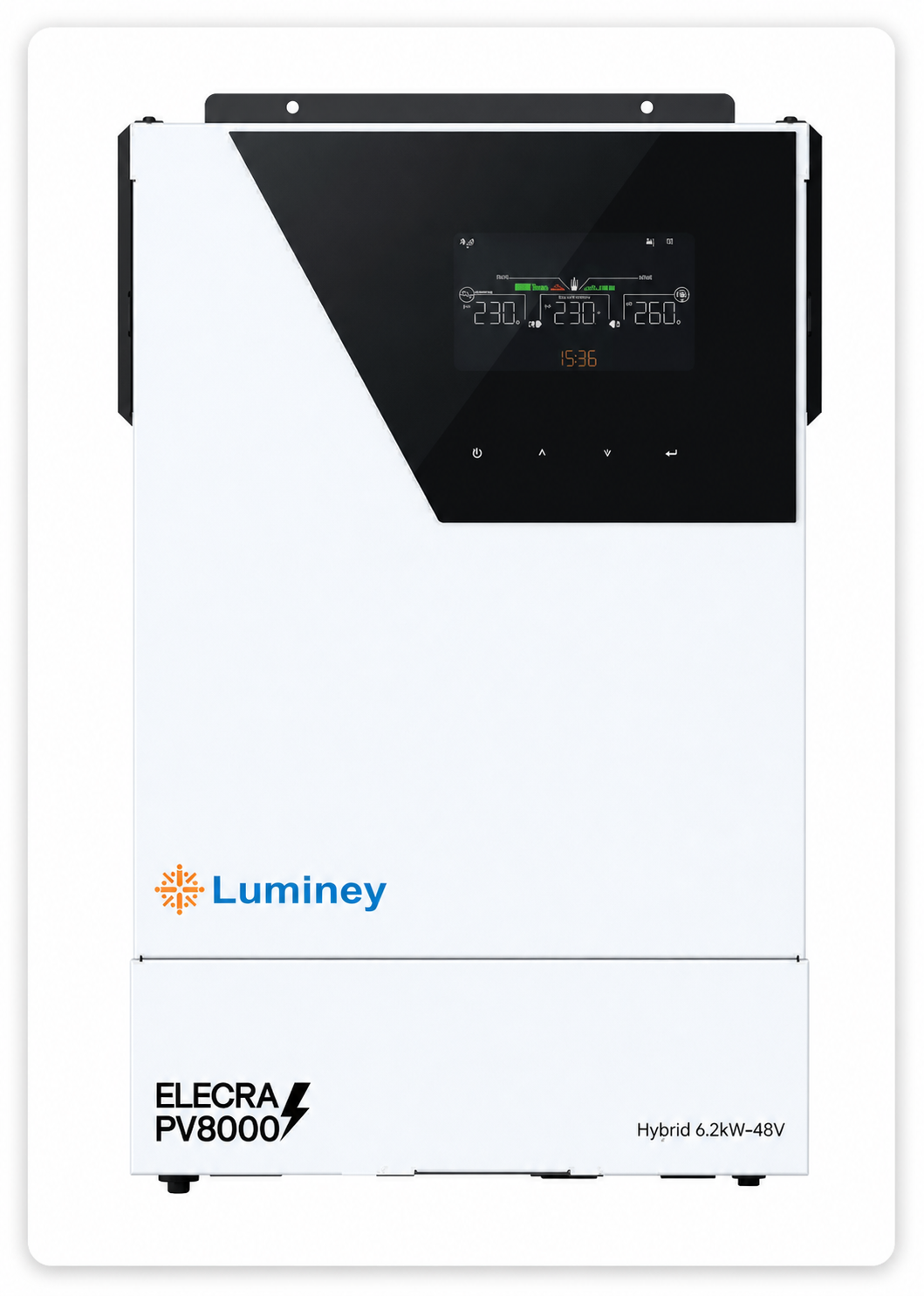
Luminey's Elecra range is the relevant starting point for solar and battery-backup discussions. Its website provides model datasheets and battery-compatibility information. Confirm the exact output rating, battery limits and operating modes before selecting a unit.
Luminey's G2 Pro and G3 on-grid ranges address a different requirement. They should not be presented as standalone battery-backup replacements for a home UPS.
The practical Luminey advantage is being able to compare inverter ranges, compatible storage and published technical information within one product ecosystem. Luminey also states that customer-care centres and installation assistance are available through its official website. Ask for the warranty and service route in writing for the exact products quoted.
Do not assume that a battery-capable inverter can export power. Confirm its documented operating modes and any applicable grid-connection approvals separately.
A conventional grid-charged UPS depends on the available charging window between outages. If another outage arrives before the battery is recharged, backup time can fall. Battery ageing, replacement cost, conversion losses and charging heat also matter.
Some compact units are designed for short electronics backup and support neither large external batteries nor motor loads. Other UPS systems have extended runtime options. Likewise, some products offer a stepped waveform while others provide a sine wave. The limitations belong to the exact model, not every product carrying the UPS label.
Solar-plus-storage has its own trade-offs: higher initial installation scope, roof requirements, weather-dependent generation, battery replacement and more design variables. Neither solution should promise a fixed saving or runtime without a load and battery assessment.
For battery selection, see Luminey's Lithium Battery Price in Pakistan guide. Use a qualified installer for fixed home wiring and protection design.
An office may need both long-duration storage for selected circuits and a UPS for computers or network equipment. A factory may need uninterrupted control power even where its grid-connected solar system reduces daytime consumption.
Do not scale a home example directly to industrial equipment. Process continuity, load surges, three-phase demand, protection coordination and shutdown procedures require an engineered design. Critical medical or safety-related equipment should follow its manufacturer's supply requirements and the applicable professional design process.
For home backup, start with the appliances and required runtime. Choose a suitable UPS for sensitive equipment, a correctly sized battery inverter for essential circuits, or solar plus storage when you also want daytime generation.
Explore Luminey's inverter options and discuss your load, battery plan and installation requirements with the Luminey team. A clear design beats a bigger number on a carton every time.


