
September 9, 2026
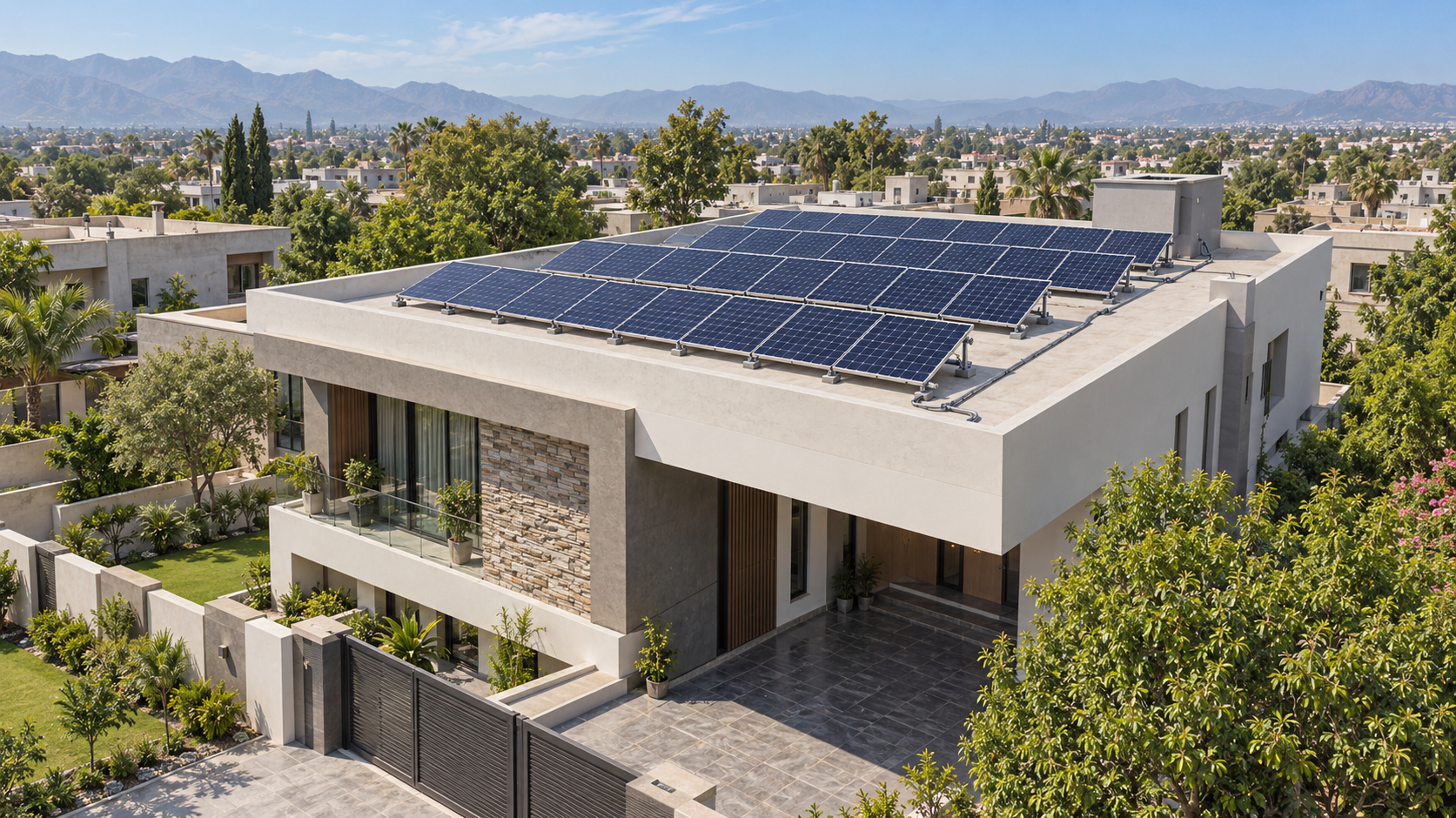
The solar panel installation cost in Pakistan cannot be judged from the price of solar panels alone. A complete residential solar quotation normally includes the panels, inverter, mounting structure, electrical protection, cables, earthing, installation, testing and, where required, battery storage and prosumer-related work.
As a practical 2026 planning range, a professionally installed 3kW on-grid solar system may cost around PKR 350,000-500,000, a 5kW system around PKR 650,000-850,000, and a 10kW on-grid system around PKR 850,000-1.4 million. Hybrid systems cost more because lithium battery storage and additional control equipment are added. These figures are budgeting ranges rather than fixed Luminey quotations.
That is why two quotations for the same 5kW or 10kW system can differ by several lakh rupees without necessarily describing the same installation.
The important question is not simply "How much is solar?" It is: "What exactly is included in this solar quotation, and is the complete system properly designed for my home?"
This guide explains how solar installation pricing works in Pakistan, current September 2026 solar panel rates, the difference between panel cost and system cost, what you should expect in a professional quotation, battery requirements and how much load common system sizes can realistically support.
For homeowners comparing quotations, these ranges provide a useful starting point:
For homeowners comparing quotations, these ranges provide a useful starting point:These prices vary with panel and inverter brands, battery capacity, installation quality, roof structure, electrical work, location and what the installer actually includes in the quotation.
For more detailed sizing, compare Luminey's 3kW solar system price guide, 5kW solar system price guide and 10kW inverter price guide.
A common mistake is comparing a solar panel price in Pakistan with the price of a complete installed solar system.
They are different figures.
If a dealer says a panel costs PKR 42 per watt, that figure normally applies only to the photovoltaic module.
A complete installation also requires an inverter, mounting structure, wiring, DC and AC protection, isolators, surge protection, earthing, connectors, labour and commissioning. A hybrid installation adds another major expense: battery storage.
This is why multiplying a panel's per-watt price by 5,000W does not tell you what a complete 5kW system will cost.
Panel-only calculation
5,000W x PKR 42/W = PKR 210,000
That may estimate the module cost, but it does not mean a professionally installed 5kW solar system costs PKR 210,000. The inverter, structure, cables, electrical protection, installation and other project costs still have to be included.
Luminey's detailed solar inverter price guide for Pakistan explains why inverter type and capacity can substantially change the final system price.
Solar panel prices change frequently because of inventory, brand, technology, dealer margins, taxes, currency movements and wholesale versus retail purchasing.
For September 2026 budgeting, many commonly available modules can be planned at roughly PKR 38-48 per watt, although exact rates vary by brand, technology, seller and model.
These are market-planning references rather than guaranteed Luminey retail prices. Solar pricing can change quickly, so compare quotations issued on approximately the same date.
The solar panel cost per watt in Pakistan for a 585 watt module is one of the most searched pricing questions because panels around this wattage are commonly used in residential installations.
At approximately PKR 38-48 per watt:
So a reasonable market-planning range is approximately PKR 22,000-28,000 per 585W panel, with some brands or technologies sitting outside that range.
But wattage should not be the only buying criterion. Check the exact:
A properly engineered system starts with electrical compatibility, not whichever panel happens to have the lowest rupee-per-watt rate.
The quotation should identify the manufacturer, model, wattage, quantity and total DC array capacity.
For example, do not accept "10kW Tier-1 panels" when the installer can instead specify the exact panel models, quantity and total installed wattage.
The inverter converts DC electricity generated by the panels into electricity that can be used by household or commercial loads.
The quotation should state whether it is on-grid, hybrid or off-grid. This distinction matters because each architecture performs a different function.
Luminey's on-grid vs off-grid solar guide explains how grid-connected, hybrid and independent systems behave differently during normal operation and load shedding.
Panels need a properly designed mounting system that can safely support them on the roof. The quotation should clarify whether the project includes standard rooftop mounting, an elevated structure, custom rails or other structural work.
Roof height, wind exposure, access and steel requirements can all change the cost.
Solar panels operate on DC electricity before reaching the inverter. Correct cable sizing helps minimise losses and keeps current within safe operating limits. The installation may also require appropriate solar connectors, conduits, cable trays and weather-resistant routing.
Protection equipment is not a decorative extra. Depending on the design, this may include DC isolators, AC isolators, circuit breakers, fuses, surge protection devices and appropriate distribution equipment.
Cheap quotations sometimes become cheaper by reducing the quality or scope of these less-visible components.
Proper earthing helps protect equipment and users when electrical faults or abnormal voltages occur. A quotation should clarify the earthing scope rather than simply saying "complete installation".
An on-grid system normally does not need a battery. A hybrid or off-grid system may require lithium storage, and battery capacity can become one of the largest parts of the project cost.
As a planning reference, a typical 5.12kWh lithium battery may sit around PKR 205,000-310,000, while approximately 10kWh of storage may cost around PKR 445,000-570,000 before installation.
Read the full Lithium Battery Price in Pakistan 2026 guide before comparing storage quotations.
Labour includes much more than putting panels on a roof. A professional installation can involve site preparation, structure assembly, cable routing, inverter mounting, distribution-board work, battery connections, safety checks, configuration and testing.
Modern solar and storage systems may provide Wi-Fi or app-based monitoring. Correct inverter settings are especially important for hybrid systems because charging limits, battery communication, backup outputs and operating priorities must match the installed equipment.
A system should be tested before handover. Commissioning helps verify correct wiring, string voltage, inverter configuration, protection, battery communication and basic operating performance.
Grid-connected homeowners planning to export electricity should confirm whether the quotation includes the relevant application, drawings, inspections, metering work and associated charges.
Pakistan's regulatory framework changed in 2026 with the introduction of the NEPRA Prosumer Regulations, 2026. Homeowners should verify the current rules and applicable arrangements rather than relying on older net-metering information.
Review the NEPRA Prosumer Regulations, 2026 on NEPRA's official website.
The lowest upfront quotation can become expensive when nobody answers the phone after installation. Check who handles panel warranty, inverter warranty, battery warranty, installation faults and technical support.
Luminey provides product and customer-support routes through its contact page.
For solar panels for home the answer depends first on how large a system you actually need. A small household may be adequately served by 3kW. A medium household with an inverter AC and higher daytime consumption may be better suited to 5kW. A larger house operating several cooling loads may require 10kW or more.
The unusually wide range exists because the phrase "10kW solar system" does not describe the complete bill of materials. One 10kW quotation may have no battery. Another may contain 20kWh of lithium storage. Those are fundamentally different energy systems.
The most accurate way to price residential solar is to start with the home rather than with a pre-made package.
A solar installer should ideally consider:
For example, two houses using 800 electricity units each month may still need different systems. One family may use most electricity during daylight hours. Another may consume heavily after sunset. The first household may benefit strongly from an on-grid system. The second may want a hybrid inverter and battery storage so daytime solar can be shifted into evening use.
Pakistan has substantial solar-resource potential, but actual generation still changes with location, panel orientation, temperature, shading, dust and system design. For technical planning, review the World Bank solar PV resource information or use the PVWatts solar production calculator.
Price differences are normal when the equipment or project scope differs. What should concern a buyer is a large difference when both companies claim to be quoting the same thing.
A quotation can become cheaper by changing panel grade, inverter brand, steel quantity, cable size, protection equipment, earthing scope, installation quality, battery size, warranty support or included paperwork.
There are also legitimate site-related differences. A standard RCC rooftop with an inverter installed close to the panels may require less cabling and structure than a property where panels are installed on an elevated frame several floors above the inverter.
That is why a written bill of materials and scope of work is more useful than the headline price alone.
The so-called 20% rule for solar panels is generally used as a planning guideline rather than a Pakistani legal requirement. The idea is to avoid designing a solar array around perfect laboratory output. Some designers use around 10-20% additional generation margin to account for factors such as heat, dust, wiring losses, imperfect orientation, seasonal changes and normal real-world performance losses.
For example, if a calculation indicates that 5kW is required under ideal assumptions, a designer might investigate whether additional PV capacity is appropriate.
However, you should not automatically multiply every household requirement by 1.2.
In 2026 Pakistan, system sizing should also consider daytime self-consumption, inverter PV-input limits, roof capacity, sanctioned load, current prosumer regulations and the economics of exporting surplus power. The right approach is to model expected annual generation and consumption instead of following a single percentage rule.
Possibly, but it depends on the actual running load of the air conditioners and everything else operating at the same time.
A 5kW inverter does not mean every combination of appliances below a theoretical 5,000W will operate perfectly in all conditions. Two efficient inverter ACs may be possible during strong sunlight when their combined running demand is moderate and other heavy appliances are controlled.
However, simultaneously adding an iron, water pump, electric geyser, microwave or other high-power appliance could push the system beyond its safe operating limit. Solar production also varies throughout the day. Morning, late-afternoon, cloudy and dusty conditions will not deliver the same PV power as clear midday sunlight.
For a detailed home-load example, use Luminey's 5kW Solar System Price in Pakistan guide.
Running three air conditioners on a 5kW system should not be treated as a normal design assumption. Three highly efficient inverter ACs operating at unusually low compressor loads may occasionally remain under 5kW, but designing a house around that best-case scenario leaves very little capacity for refrigerators, fans, lights, pumps and other appliances.
Startup behaviour and changing compressor speeds also matter. For a household that routinely needs three ACs at the same time, a larger inverter and PV array should normally be evaluated rather than forcing the requirement into a 5kW system. A load survey is more reliable than counting appliances.
A properly sized 10kW solar system can commonly support two or three efficient 1.5-ton inverter ACs plus normal household loads during strong solar-production hours, provided the total live demand remains within the inverter's capacity.
Whether a fourth AC is possible depends on the actual wattage of every AC and the background load. The key equation is:
Total simultaneous appliance load <= usable inverter output
But even that is only part of the calculation. For nighttime operation, you also need enough battery energy in kWh.
Wondering how many batteries for a 10kw solar system? There is no rule saying a 10kW solar system requires a specific number of batteries. Inverter power is measured in kW. Battery energy is measured in kWh. They answer different questions.
A 10kW inverter tells you approximately how much power the system can supply at once. A 10kWh battery tells you approximately how much energy can be stored for later use.
Explore Luminey's residential energy-storage options for current product configurations.
Battery capacity alone is still not enough. The installer must also verify battery voltage, BMS communication, continuous current, inverter compatibility, charging rate and approved parallel configuration.
Instead of comparing only the final number at the bottom of each quotation, put competing proposals side by side and check whether they contain the same scope.
Ask each installer to specify the panel brand and model, total panel wattage, inverter model, structure specification, battery capacity, cable sizes, AC/DC protection, earthing, installation work, monitoring, documentation, warranty and after-sales responsibility.
Also ask whether transport, elevated structures, civil work, extra cable runs, meter work or application-related charges can be added later.
A quotation that appears PKR 100,000 cheaper but excludes several required components is not actually PKR 100,000 cheaper.
A good solar system is not automatically the largest one you can afford. It is the system that matches how much electricity you use, when you use it, what must stay powered during an outage and how much you want to spend on storage.
For a deeper comparison, read On-Grid vs Off-Grid Solar: Which System Is Right for Pakistan?.
The most useful solar quotation begins with your electricity bills, roof and appliances rather than a generic package.
Share your recent electricity consumption, city, available roof area, number of ACs, daytime loads and required backup duration so the system can be sized around real operating conditions.
Luminey provides on-grid inverters, hybrid solutions and residential energy storage. You can contact Luminey for a solar system recommendation or quotation based on your project requirements.