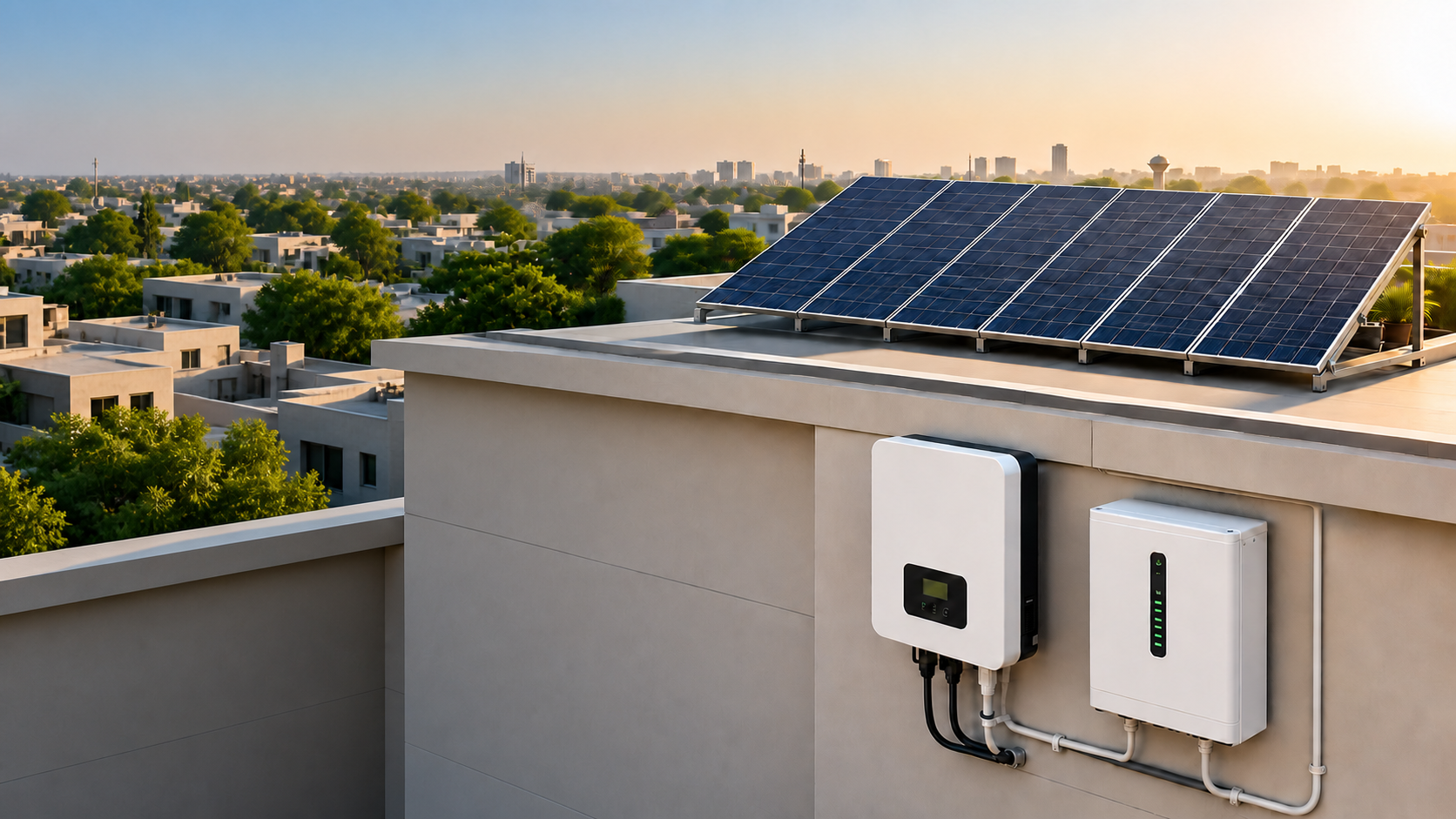
A complete 3kw solar system price in Pakistan about PKR 350,000 to PKR 850,000 in 2026. An on-grid system without a battery usually costs PKR 350,000 to PKR 500,000, while a hybrid system with a 5kWh lithium battery generally costs PKR 620,000 to PKR 850,000.
The wide range exists because a quote marked "3kW" may include very different equipment. One quote may cover panels and an on-grid inverter only. Another may include a hybrid inverter, lithium battery, elevated structure, safety devices, installation, and paperwork.
3kW Solar System Price in Pakistan 2026: At a Glance
The following ranges are for budgeting, not fixed Luminey quotations. They reflect public Pakistan market guides and packages reviewed on 10 August 2026.
Typical 2026 prices for 3kW solar systems in Pakistan
3kW system type
Typical 2026 price
Battery backup
Best for
On-grid, no battery
PKR 350,000 to 500,000
No
Homes with a stable grid and high daytime use
Hybrid, battery-ready
PKR 390,000 to 520,000
No battery included
Buyers who plan to add storage later
Hybrid with tubular batteries
PKR 500,000 to 650,000
Basic backup
Lower upfront storage cost
Hybrid with about 5kWh lithium battery
PKR 620,000 to 850,000
Stronger, deeper backup
Homes needing reliable load-shedding protection
Off-grid with battery storage
PKR 600,000 to 850,000
Required
Remote sites or areas with an unreliable grid
Why Two 3kW Quotations can Differ by Several Lakh
A useful quotation should name every included item. Price changes with:
Panel brand, wattage, cell type, grade, and warranty
On-grid, hybrid, or off-grid inverter type
Tubular or lithium battery chemistry and capacity
Standard roof-mounted or elevated steel structure
Cable quality, earthing, breakers, surge protection, and isolators
Site height, transport, civil work, and installation difficulty
Monitoring hardware, commissioning, warranty, and after-sales support
Prosumer application, meter, and documentation costs, when applicable
The lowest quotation is not automatically the cheapest system to own. Missing protection, weak installation, or unclear warranty support can create larger costs later.
What is included in a Complete 3kW Solar System?
A complete system normally contains more than solar panels.
Solar system components, what each one does, and typical planning cost ranges
Component
Plain-language job
Typical planning range
Solar panels
Produce electricity from sunlight
PKR 120,000 to 165,000
On-grid inverter
Converts solar power for home and grid use
PKR 90,000 to 140,000
Hybrid inverter
Manages solar, grid, and battery power
PKR 120,000 to 200,000
Mounting structure
Holds panels safely above the roof
PKR 25,000 to 70,000
Wiring and protection
Connects and protects the system
PKR 25,000 to 50,000
Installation and commissioning
Builds, tests, and starts the system
PKR 25,000 to 50,000
Tubular battery bank
Stores limited backup energy
PKR 100,000 to 250,000
About 5kWh lithium battery
Stores more usable energy with deeper cycling
PKR 180,000 to 330,000
Component ranges overlap and should not be added blindly. Installers package labour, transport, structure, and protection differently. Request a line-by-line bill of materials before paying an advance.
How many Solar Panels are needed for a 3kW System?
Most modern 3kW systems use five or six panels.
Panel configuration options for a 3kW solar system
Panel option
Total panel capacity
Practical note
5 panels x 585W
2.925kW
Common compact configuration
5 panels x 600W
3.0kW
Exact nameplate match
5 panels x 620W
3.1kW
Slightly oversized array
6 panels x 550W
3.3kW
More panel capacity for weaker conditions
A panel array can be slightly larger than the inverter's AC output when the inverter manufacturer permits it. The extra panel capacity can improve morning and winter generation, but the installer must stay within the inverter's voltage, current, and total PV input limits.
Plan for roughly 180 to 220 square feet of unshaded roof space. Actual space depends on panel dimensions, walking clearance, row spacing, roof obstacles, and structure angle.
Which Solar Panel is Best for a 3kW System?
Choose genuine, traceable panels with a clear product warranty and local claim route. N-type TOPCon panels from established manufacturers are popular because they offer high output in limited roof space. Panel authenticity, installer quality, shade control, and correct string design matter more than choosing a logo from a generic list.
Ask the seller for:
Exact brand and model number
Panel serial numbers and verification method
Product and performance warranty documents
Flash-test or power-tolerance information
Physical inspection for cracks, damaged frames, and poor connectors
A layout showing shade, direction, tilt, and maintenance access
How much Electricity does a 3kW Solar System Produce?
A well-installed 3kW array can produce roughly 3,600 to 4,800 units per year, or about 300 to 400 units in an average month. Summer and winter output will not be equal.
The World Bank solar resource report for Pakistan places much of Pakistan near 1,400 to 1,600kWh of annual output per installed kWp. Multiplying that range by 3kWp gives about 4,200 to 4,800kWh before allowing for a specific roof's shade, orientation, dirt, downtime, and design limitations.
Planning figure: Use 10 to 13 solar units per day for a practical 3kW household estimate. A site survey should replace this estimate before purchase.
Generation falls when panels are shaded, dusty, too hot, poorly angled, mismatched, or disconnected during grid outages. On-grid inverters also stop producing usable output during an outage unless the system has a supported backup function.
How many Appliances can run on a 3kW Solar System?
A 3kW inverter can supply up to its rated output under specified conditions. For comfortable operation, keep normal simultaneous use below the ceiling and leave room for compressor or motor startup.
Typical Appliance Power in a Pakistani Home
Typical running power of common household appliances
Appliance
Typical running power
Easy way to think about it
LED bulb
8W to 12W
Ten bulbs use about 100W
Ceiling fan
60W to 90W
Four fans use about 240W to 360W
Wi-Fi router
10W to 20W
Small load, often used all day
Laptop
45W to 100W
Depends on charger and workload
LED television
80W to 150W
Larger screens usually use more
Refrigerator
100W to 300W while running
Compressor startup needs extra power
Washing machine
400W to 800W
A built-in heater uses much more
Water pump
750W to 1,500W
Startup surge can be several times higher
Electric iron
1,000W to 2,000W
Uses a large part of the system alone
Microwave
1,200W to 1,800W
Short use, but high instant demand
1-ton inverter AC
700W to 1,500W
Heat, temperature setting, and room size matter
Electric kettle
1,500W to 2,200W
Avoid with AC, iron, or pump together
These figures are planning ranges. Check the label on each appliance or ask the installer to measure real demand.
A Comfortable Daytime Load without AC
This combination normally stays well within a 3kW limit:
Four ceiling fans: about 300W
Eight LED lights: about 80W
One refrigerator: about 200W while running
One television: about 100W
Wi-Fi router: about 15W
Two laptops and phone chargers: about 150W
Estimated running load: about 845W. The remaining capacity provides room for appliance variation and occasional use of a washing machine.
A Managed Daytime Load with One Inverter AC
This combination can work during good sunlight:
One 1-ton inverter AC: about 900W to 1,400W
Four fans: about 300W
Refrigerator: about 200W
Eight lights: about 80W
Television, router, and laptops: about 250W
Estimated running load: about 1,730W to 2,230W. Do not add an iron, kettle, microwave, or water pump without checking the live load first.
Can a 3kW Solar Panel System run an AC?
Yes, a properly designed 3kW system can run one efficient 1-ton inverter AC during sunny hours with essential household loads. The system may struggle when the AC is old, the weather is extremely hot, panels are producing less than expected, or several heavy appliances run together.
A 1.5-ton inverter AC can also fit in some carefully managed situations, but it leaves less headroom. Measure the AC at peak afternoon temperature before treating it as a safe load.
Running an AC at night is a battery question, not only an inverter question. A small battery may run fans and lights for hours but support an AC for a much shorter period.
Battery Options for a 3kW Solar System
The battery decides backup timefor Solar System Prices in Pakistan. The inverter decides how much power can be supplied at once.
Battery storage options, usable energy, and example backup duration
Battery option
Approximate usable AC energy
Example backup at 500W
Best for
No battery
0kWh
No outage backup
Lowest-cost daytime savings
Two 12V 185Ah tubular batteries
About 1.7 to 2.0kWh
About 3 to 4 hours
Fans, lights, router, and limited essentials
5.12kWh lithium battery
About 4.0 to 4.6kWh
About 8 to 9 hours
Longer essential-load backup
10kWh lithium storage
About 8 to 9kWh
About 16 to 18 hours
Longer outages or heavier evening use
Backup estimates allow for normal discharge limits and conversion losses. Battery condition, temperature, inverter settings, wiring, and load changes affect real results.
What can a 5kWh Lithium Battery Run?
A healthy 5.12kWh lithium battery can often deliver around 4.0 to 4.6kWh of practical AC energy, depending on system settings.
A 500W essential load can run for about 8 to 9 hours.
A 1,000W load can run for about 4 hours.
A 1,500W load can run for about 2.5 to 3 hours.
A 2,000W load can run for about 2 hours.
These are simple estimates, not guarantees. An AC cycles up and down, while a pump or refrigerator may have a short startup surge.
On-grid, Hybrid, or Off-grid: Which 3kW System is Right?
On-grid, hybrid, and off-grid solar systems compared
System type
Works with grid
Uses battery
Works during outage
Best reason to choose it
On-grid
Yes
Usually no
No
Lowest upfront cost for bill reduction
Hybrid
Yes
Optional or included
Yes, with battery
Savings plus backup and future flexibility
Off-grid
No grid required
Yes
Yes
Power for remote or highly unreliable locations
Choose on-grid if the electricity supply is stable and daytime bill reduction is the main goal. Choose hybrid if load shedding, evening use, or future battery expansion matters. Choose 3kW Off grid solar system price in Pakistan only after sizing enough panels and storage for weak winter days.
How the 2026 Prosumer Rules affect Savings
Pakistan's NEPRA Prosumer Regulations 2026 use net billing for new prosumer arrangements. Imported units are billed at the applicable retail tariff, while exported units receive credit at the national average energy purchase price. NEPRA can revise that purchase rate.
This makes daytime self-consumption more valuable than unnecessary export. Run the AC, washing machine, water pump, and other flexible loads during solar hours where practical.
Do not assume solar will remove every bill. Fixed charges, taxes, nighttime imports, low export credit, seasonal generation, and system downtime can leave a payable amount.
3kW Solar System Benefits and ROI in Pakistan
A correctly sized 3kW Solar System Price In Pakistan (2026): Benefits & ROI can lower grid purchases, provide backup when batteries are included, and reduce exposure to future tariff increases. The return depends on how much solar energy the home uses directly.
Simple on-grid ROI example
Assume:
Installed on-grid price: PKR 430,000
Annual solar generation: 4,200 units
Daytime self-use: 70%, or 2,940 units
Avoided grid energy value: PKR 50 per unit
Exported energy: 1,260 units
Illustrative export credit: PKR 10 per unit
Calculation:
Self-use value: 2,940 x PKR 50 = PKR 147,000 per year
Export value: 1,260 x PKR 10 = PKR 12,600 per year
Total illustrative annual value: PKR 159,600
Simple payback: PKR 430,000 divided by PKR 159,600 = about 2.7 years
A more cautious planning range is 3 to 5 years for on-grid and 5 to 8 years for a battery-backed hybrid system. Batteries add resilience and comfort, but their cost usually lengthens financial payback.
The PKR 50 and PKR 10 values above are examples, not tariff claims. Replace them with the effective retail rate on your bill and the current export rate for your agreement.
Use this ROI formula with your own Bill
Key point: Annual solar value = self-used units x avoided grid rate + exported units x export credit
Key point: Simple payback in years = complete installed price divided by annual solar value
This calculation excludes financing cost, maintenance, battery replacement, degradation, taxes, and fixed grid charges.
3kW versus 3.5kVA solar system
Kilowatts and kilovolt-amperes are not always equal. A 3kW inverter provides 3,000 watts of real power. A 3.5kVA inverter can provide 3.5kW only when its rated power factor is 1.0. At a 0.8 power factor, 3.5kVA equals 2.8kW.
Do not compare a 3.5kVA solar system price in Pakistan with a 3kW package until the seller confirms:
Rated continuous output in watts
Surge output and duration
Power factor
Solar panel input limit
Battery voltage and maximum battery current
Warranty and protection features
3kW versus 5kW Solar System Price in Pakistan
A 3kW system is usually enough for a small home with one carefully managed AC. A 5kW system is better when monthly use regularly exceeds 450 to 500 units, two ACs may overlap, or the family expects demand to grow.
3kW versus 5kW solar system comparison
Comparison
3kW system
5kW system
Typical monthly use
About 250 to 450 units
About 450 to 700 units
Typical AC use
One efficient AC with load management
More room for one AC and heavier loads, or limited overlap
Approximate roof area
180 to 220 sq ft
300 to 380 sq ft
Upfront cost
Lower
Higher
Expansion risk
Can become tight as loads grow
Better headroom for a growing home
If future plans include a second AC, electric water heating, an EV charger, or a home office with powerful computers, compare a 5kW solar system before buying.
Solar Price in Pakistan on Installment
Solar financing can reduce the upfront payment, but markup and fees increase the total ownership cost. Compare the cash price, down payment, monthly installment, processing fee, insurance, early settlement rules, approved vendor list, and total amount paid.
Do not choose a larger system only because the monthly installment looks affordable. First compare the installment with realistic monthly savings under net billing.
Should you Buy a 3kW Solar System from OLX?
An OLX listing can help you see asking prices, but it is not proof of product condition, authenticity, or warranty. Used panels may have invisible microcracks. Used batteries may have lost capacity. An inverter warranty may not transfer to a second owner.
Before buying used equipment:
Verify the model and serial number with the manufacturer or distributor.
Ask for the original invoice and warranty card.
Test inverter output, battery health, and panel performance.
Inspect for repair marks, corrosion, heat damage, and connector problems.
Calculate the cost of missing structure, protection, cables, transport, and installation.
Use a qualified installer for testing. A cheap used package can become expensive when one major component fails.
Where Luminey fits in a 3kW Home Solar Plan
Luminey focuses on the two parts that decide how comfortably a home uses solar: power conversion and energy storage. The Luminey Elecra hybrid range is designed to manage solar, grid, and compatible batteries, while the residential storage range covers Monawall and Atrix batteries.
Luminey's published product information highlights practical ownership features:
Elecra family features include built-in Wi-Fi and app monitoring, dual output, short-circuit protection, and up to 500V DC input across the published range.
Monawall lists IP65 water and dust protection, built-in Wi-Fi, 1C discharge, 100% depth of discharge, and 6,000 life cycles.
Atrix lists simple installation, optional battery app support, 0.5C or 1C charging and discharging, and expansion up to 120kWh.
Luminey publishes customer-care locations in Lahore, Multan, Islamabad, Faisalabad, and Peshawar, plus a central support number.
These features do not remove the need for correct system design. A 3kW panel array must still match the chosen inverter's PV voltage and current window. The battery must also match the inverter's voltage, current, firmware, and communication requirements.
The practical difference is the connected product path. A homeowner can begin with a suitably sized Elecra hybrid setup, add a compatible storage option where the model permits, monitor the system, and use Luminey's published local support route if help is needed.
Model net-billing savings. Use realistic self-consumption instead of assuming every exported unit cancels one imported unit.
Frequently Asked Questions
How much will a 3kW solar system cost?
A complete 3kW solar system costs about PKR 350,000 to PKR 850,000 in
Pakistan during 2026. On-grid systems sit near the lower end. Hybrid or
off-grid systems with lithium batteries, elevated structures, stronger
protection, and installation sit near the upper end.
How many appliances can run on 3kW?
A 3kW system can run lights, four to six fans, a refrigerator,
television, router, laptops, and one efficient inverter AC with careful
load management. Avoid operating the AC, iron, kettle, microwave, and
water pump together because their combined demand can exceed the
inverter limit.
Can a 3kW solar panel system run AC?
Yes, a correctly designed 3kW system can run one efficient 1-ton
inverter AC during strong sunlight with basic household loads.
Nighttime AC use needs enough battery energy and output power. A
1.5-ton AC requires closer measurement and stricter management of other
appliances.
How many panels make a 3kW solar system?
Most current 3kW systems use five or six panels. Five 600W panels equal
3kW, while six 550W panels equal 3.3kW. Slight panel oversizing can
improve weaker-hour production when the inverter manufacturer allows the
array's voltage, current, and total input.
How many units does a 3kW system generate?
A well-installed 3kW system in Pakistan can generate roughly 300 to 400
units per average month, or about 3,600 to 4,800 units yearly. City,
season, shade, dust, panel direction, heat, equipment quality, and
downtime change actual production.
Does a 3kW solar system need a battery?
A battery is optional for on-grid bill reduction but required for useful
backup during outages. Choose no battery for the lowest upfront price.
Choose hybrid storage when evening use, load shedding, or future energy
independence matters more than the shortest financial payback.
How long will a 5kWh battery provide backup?
A 5.12kWh lithium battery can provide about 4.0 to 4.6kWh of practical
AC energy. That is roughly eight hours at 500W, four hours at 1,000W, or
about two hours at 2,000W. Settings, temperature, age, and losses affect
runtime.
Is on-grid, hybrid, or off-grid better?
On-grid is best for low-cost daytime bill reduction where the grid is
stable. Hybrid is best for solar savings plus battery backup. Off-grid
is best for remote or unreliable locations, but it needs enough storage
and panels for weak winter days.
Is a 3.5kVA inverter the same as 3kW?
Not always. A3.5 kVA solar system price in Pakistan inverter equals
3.5kW only at a 1.0 power factor. At 0.8 power factor, 3.5kVA equals
2.8kW. Compare rated continuous watts, surge duration, solar input,
battery limits, and power factor before comparing prices.
Which solar panel is best for 3kW?
The best panel is genuine, correctly sized, shade-free, and backed by a
clear local warranty. High-wattage N-type TOPCon panels are popular for
limited roofs, but proper string design, serial verification, safe
mounting, and installation quality matter more than brand popularity
alone.
How much roof space does 3kW need?
A modern 3kW array usually needs about 180 to 220 square feet of clear
roof. Final space depends on panel dimensions, row gaps, tilt, access
paths, water tanks, parapet shadows, and structure height. A site layout
should confirm usable area.
Can I buy a 3kW solar system on installment?
Yes, several Pakistani banks and retailers offer solar financing or
installment plans. Compare cash price, down payment, markup, processing
fees, insurance, approved vendors, tenure, and total repayment.
Eligibility and available system sizes vary, so confirm current terms
directly with the provider.
Is buying a 3kW system from OLX safe?
Buying through OLX can be safe only after technical inspection and
serial verification. Ask for invoices and transferable warranty
documents. Test panel output, inverter condition, and battery health.
Add missing structure, protection, transport, and installation costs
before comparing the used price.
Does net billing change 3kW solar savings?
Yes. Under Pakistan's 2026 prosumer rules, imported and exported
electricity have different values. A household usually gains more by
using solar directly during the day than by exporting surplus. Shift AC,
washing, pumping, and other flexible loads into solar hours.
Should I choose 3kW or 5kW solar?
Choose 3kW when monthly use is roughly 250 to 450 units and one AC is
carefully managed. Compare 5kW when use exceeds about 450 to 500 units,
two ACs may overlap, or future plans include electric heating, EV
charging, or heavier office loads.