
October 27, 2026
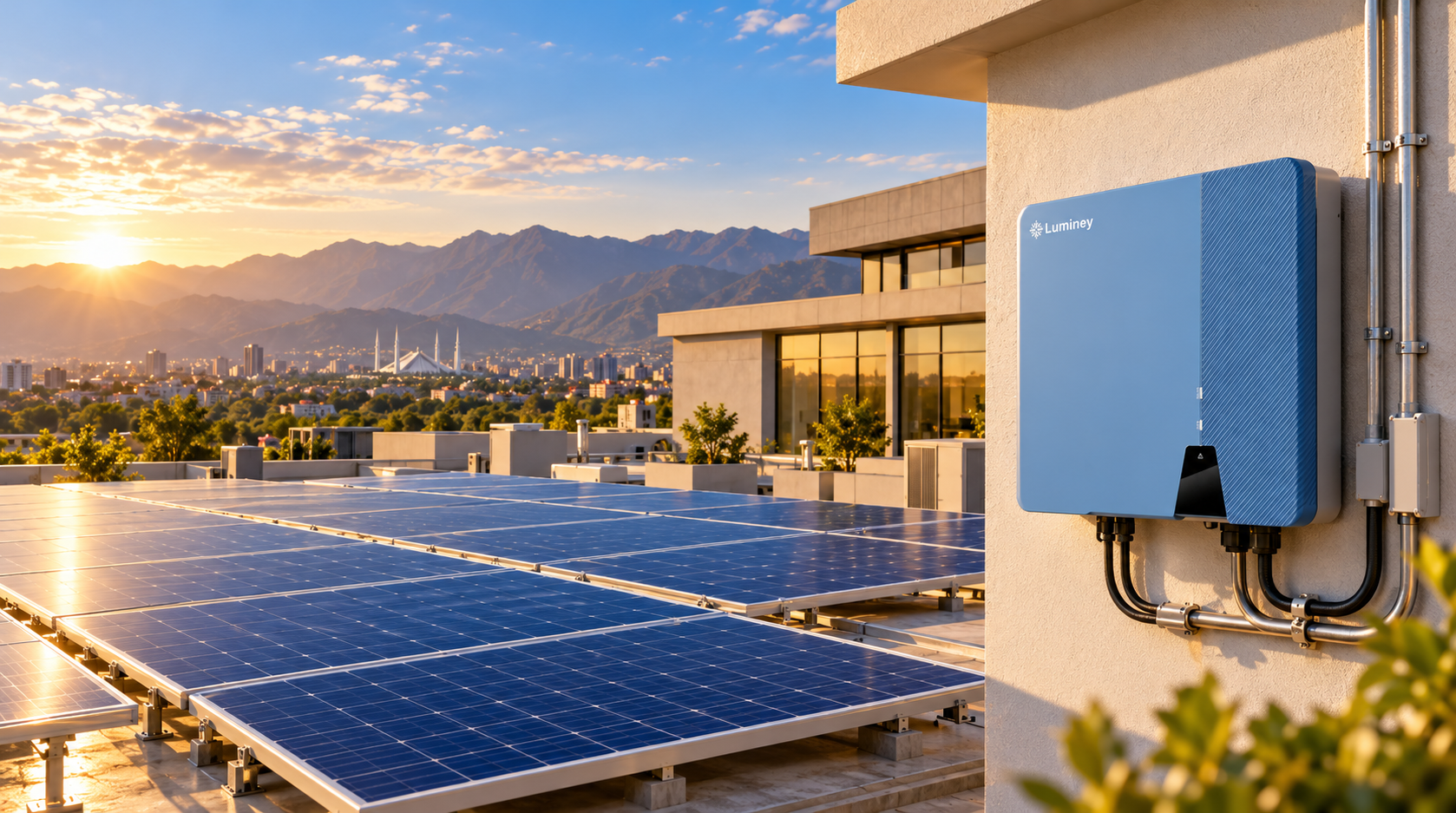
Luminey's G2 Pro and G3 ranges give Pakistani businesses a starting point for comparing three-phase on-grid solar. The buying decision, however, starts with how your building uses electricity: which loads operate during daylight, what sits on each phase and which equipment must keep running during an outage.
A three-phase solar inverter converts solar DC into AC across three phases. A suitable on-grid installation can offset daytime grid purchases; a suitable hybrid installation can also coordinate compatible battery storage. Three-phase output alone does not provide backup, guarantee balanced building loads or establish suitability for every motor.
This guide covers selection, sizing, battery pairing and installer handover for offices, shops, schools, warehouses and factories. Large homes with three-phase service can use the same decision process, with a different load profile.
Three-phase systems serve loads through three AC phases. They can supply a building containing both three-phase machinery and single-phase circuits, provided the electrical arrangement is correctly designed. A commercial inverter must match the site's voltage, frequency, phase configuration and connection requirements.
Three-phase generation does not automatically redistribute the building's existing single-phase appliances. If one phase carries more demand, a balanced on-grid inverter may still leave different import or export conditions on each phase. Metering and billing treatment must be checked separately.
For backup, ask an additional question: how much power can the inverter actually supply on each phase? A total system rating may conceal a lower per-phase ceiling. Supported load imbalance, surge behaviour and neutral requirements are model-specific. Sunways highlights these checks in its three-phase hybrid selection guide.
Luminey's official on-grid inverter catalogue lists the following options:
These are on-grid ranges. Do not present either as a standalone battery-backup hybrid. If continuity is required, request a complete proposed storage architecture and an explanation of how essential loads operate when the utility supply fails.
Starting with Luminey makes the comparison practical: choose a relevant published capacity, then check the model documentation against the project. Its official website also provides a route to product and installation support. Ask for the actual warranty document and local claim process rather than assuming every model has identical coverage.
For the wider selection framework, read Luminey's Best Solar Inverter in Pakistan guide.
These sites may have useful daytime demand from lighting, computers, air conditioning and refrigeration. Match the PV production estimate to actual opening hours and seasonal usage. A school roof can generate power during holidays even when the building needs little electricity.
Identify the circuits that require continuity: network equipment and selected lighting may need backup while most air conditioning can remain outside the backup scope. A solar proposal should state that distinction clearly.
Review shift patterns, motor loads, compressors, welding equipment and variable-frequency drives. A monthly bill records energy use but does not show all starting events or the demand on each phase.
Grid-connected PV can offset part of the site's demand while the utility supports the remaining load. During islanded backup, the inverter and storage arrangement must instead support the selected loads within their own ratings. That is a different design problem.
Manufacturers' application guides, such as Afore's commercial and industrial overview, are useful starting references. Final selection still requires the site's load measurements and the exact model documents.
A large home can have three-phase service without needing a commercial-size inverter. Size the design from simultaneous demand and the intended circuits. Avoid assuming that roof area or house size establishes either the required inverter output or battery runtime.
Define the operating objective before choosing a brand or kW rating.
For solar terminology and outage behaviour, see Luminey's On-Grid vs Off-Grid Solar guide.
Three separate single-phase inverters do not automatically form a supported three-phase backup system. Where a manufacturer permits such an arrangement, the specified units, communications, configuration and protection must all follow its documented design.
Request recent bills together with interval demand readings, phase currents and a list of major loads. Record operating hours, weekend shutdowns, seasonal changes and planned expansion. Check the incoming supply, sanctioned load and transformer or distribution-board constraints with the project engineer.
Separate the PV generation target from the backup-load target. An on-grid solar inverter is not necessarily sized to run the whole building alone, because the grid supplies the shortfall. A backup inverter must be assessed against the circuits it is expected to support during an outage.
Luminey's Solar Load Calculator for Pakistan helps organise the information, but a commercial design should also use measured site data.
Assume an office has the following simultaneous demand. This is an illustration, not a design recommendation:
At that instant, the simplified example leaves 8kW supplied by the grid, ignoring losses and reactive power. The fact that the building draws 20kW does not make the 12kW solar contribution useless. Equally, that contribution does not mean the site can run through an outage without a suitable backup design.
For a different illustrative backup unit limited to 5kW per phase, a 7kW load on one phase would exceed that phase's limit even if the other phases were lightly loaded. Read the actual inverter's permitted imbalance and output limits rather than applying this example to all products.
Commercial equipment is specified using both real power in kW and apparent power in kVA. Under balanced conditions, real three-phase power can be estimated as square root of three × line-to-line voltage × current × power factor. Use the actual supply and measured values; an installer should not apply the balanced formula blindly to an unbalanced building.
Starting current, motor controls and the inverter's surge duration matter during backup. A short overload claim cannot establish that a compressor will restart successfully under every condition. Require the installer to document and test the intended sequence.
For each proposed battery, check the inverter's approved compatibility list, voltage window, BMS protocol, firmware requirements and continuous charge/discharge limits. Low-voltage and high-voltage storage architectures are different; a battery cannot be selected from its kWh figure alone.
Suppose selected business circuits require a steady 8kW for two hours. They need 16kWh delivered to the loads. Assuming a 90% usable battery fraction and 92% conversion efficiency, the arithmetic minimum nominal capacity is 16 ÷ (0.90 × 0.92), or approximately 19.3kWh.
That calculation excludes standby consumption, temperature effects, ageing reserve and changing load. It also does not prove that a particular 19.3kWh battery can supply 8kW continuously. The engineer must check battery power and current limits, the inverter's battery-mode rating and the required operating reserve.
For storage terminology and selection, read Luminey's Lithium Battery Price in Pakistan guide.
Compare maximum DC voltage, MPPT voltage range, current limits, short-circuit limits and supported inputs. Roof sections with different orientations may benefit from independent MPPTs, but string design must still stay within the manufacturer's electrical limits.
DC array kWp is different from AC output kW. For example, a hypothetical 24kWp array connected to a 20kW inverter gives a DC-to-AC ratio of 1.2. That arithmetic does not establish that any particular 20kW model permits that array. Confirm all power, voltage and current constraints and model expected clipping.
Check temperature derating, ventilation, ingress protection, cable routes, maintenance access and the roof's structural suitability. An IP rating does not remove the need to follow the mounting and clearance instructions.
The sequence below is an owner's project checklist for a qualified installer. Exact wiring, protective-device selection and energisation procedures belong to the approved design and the manual for the equipment installed.
Record the incoming supply, distribution arrangement, roof condition, demand profile and planned backup circuits. Include existing generators or UPS equipment in the survey.
Obtain the single-line diagram, string design, equipment schedule, protection plan and proposed operating modes. Establish any DISCO application and approval requirements before planning export.
Verify model codes, serials, compatibility and mounting requirements against the approved documents. Confirm that inverter and battery locations allow installation and maintenance under the manufacturer's instructions.
Have the installer complete the specified AC, PV, battery, protection and communication work using the approved design. For export control, check meter location, CT orientation and control behaviour at the intended connection point.
Require recorded checks for phase sequence, monitoring, protective functions, battery communication and any approved export control. For backup installations, demonstrate a supervised outage, load pickup, selected motor starts and return to normal supply.
Collect final drawings, test results, serial numbers, manuals, warranty records, monitoring access and support contacts. Agree who receives fault alerts and how service requests are handled.
SetApp is SolarEdge's commissioning application, not a generic feature of three-phase inverters.
It is useful evidence that configuration, communication and commissioning are part of installation. It is not a Pakistan grid-setting manual and does not establish that Luminey products use SetApp. Request the correct regional manual and configuration records for the equipment supplied to your business.
Before buying equipment for export, check the applicable rules with the relevant DISCO and the official NEPRA legal framework. As checked on 27 October 2026, that page lists the Prosumer Regulations 2026, amendments and Technical Standards for Grid Connectivity Regulations 2026. Your project team should determine which requirements apply to the site.
Zero-export operation still requires a technically suitable design and may have connection requirements. Do not assume a control setting removes all utility obligations.
Estimate commercial value from self-consumed solar energy, applicable tariffs, maintenance, financing and any permitted export arrangement. Do not promise that rooftop PV will remove maximum-demand charges: that depends on tariff structure and whether generation or storage actually reduces the measured demand peak.
Luminey's Net Metering vs Gross Metering guide gives related billing context. Reconfirm the current agreement and rules for the actual project.
A cheaper quote can become expensive if “complete installation” quietly excludes essential-load wiring or a required meter. Those are better discovered on the quotation than on the first day the power goes out.
Use Luminey's solar installation-cost guide and solar-company selection checklist when comparing proposals.
For Pakistani businesses, a three-phase solar inverter should match the supply, daytime demand and continuity requirement. Start with Luminey's published on-grid ranges where daytime solar is the objective, then assess storage and backup separately where the business needs them.
Explore Luminey's G2 Pro and G3 inverter options and contact the Luminey team with your bills, operating hours, phase-load information and essential-load list. Ask for a documented design, complete quotation and commissioning plan before approving the project.


