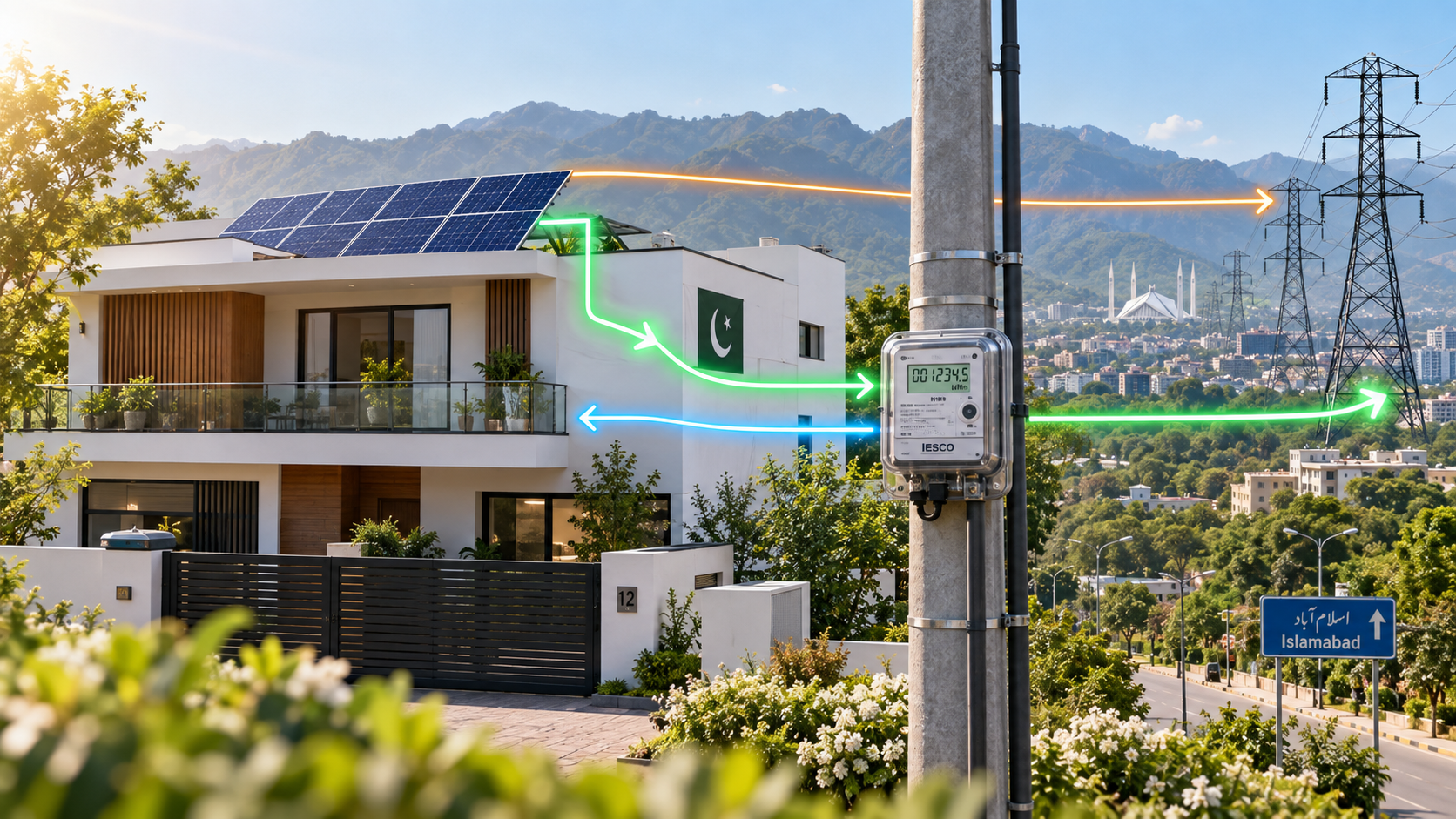
For homeowners, shop owners and factory managers, the metering model now matters as much as the panels. It decides whether a unit of solar power is worth about Rs 55 or about Rs 11. This guide explains each model in plain terms, shows the bill impact with worked examples, and covers how to design a residential, commercial or industrial system that still pays back under the 2026 rules.
Key Takeaways
Net metering = unit-for-unit swap. It gave the best returns, but new applicants can no longer get it.
Gross metering = sell all generation, buy all consumption. For the consumer this is usually the weakest of the three.
Net billing (Pakistan's current framework) = use your solar first, then export the surplus at the National Average Energy Purchase Price (reported at roughly Rs 8–11/unit, against retail tariffs of Rs 35–65+).
The new maths rewards self-consumption: run loads in the daytime, size systems to your real demand, and add battery storage to move surplus into the evening.
Commercial and industrial users with heavy daytime loads lose the least under net billing. Low-daytime-use homes lose the most.
Understanding Net Metering, Gross Metering, and Net Billing
All three models connect a rooftop solar system to the utility grid. What changes is how the Distribution Company (DISCO), such as LESCO, IESCO, MEPCO, FESCO or K-Electric, measures and pays for your energy.
Net metering vs net billing vs gross metering in Pakistan, 2026
Feature
Net metering
Net billing
Gross metering
Meter setup
One bidirectional (green) meter
Bidirectional meter; import and export recorded separately
Separate meters for generation and consumption
Solar used by your home or business
Yes, first
Yes, first
No. All generation goes to the grid
How exports are valued
1 exported unit offsets 1 imported unit
At a buyback rate (NAEPP)
Every generated unit at a feed-in or buyback rate
How imports are valued
Only net imports are billed
Full retail tariff
Full retail tariff on all consumption
Consumer benefit
Highest
Medium
Lowest
Status in Pakistan (2026)
Legacy contracts only
Current framework for new prosumers
Proposed in past reform debates; not the residential default
What is Net Metering?
Net metering lets your meter "run backwards". If your system exports 600 units in a billing cycle and you import 500 units, you are billed for zero net units and carry forward a credit. Under Pakistan's 2015 regulations, any surplus left at settlement was paid at the prevailing buyback rate, which was around Rs 26/unit before the reforms.
Because every exported unit was effectively worth the full retail tariff, net metering became one of the fastest solar payback schemes in the region. That is why the solar boom took off, and it is also why the policy was reviewed. For the full application process, fees and DISCO timelines, read our guide to net metering in Pakistan.
What is Gross Metering?
Gross metering treats your rooftop like a small power plant. Every unit your panels produce is exported and bought by the utility at a fixed rate. Every unit your building uses is imported at the normal retail tariff. You never consume your own solar power directly.
Gross metering has been used for utility-style feed-in tariff programmes around the world, and it was discussed during Pakistan's 2024–25 net metering reform debates (Business Recorder analysis). When the retail tariff is several times higher than the buyback rate, gross metering is financially the weakest option for the consumer.
What is Net Billing in Solar?
Net billing measures imports and exports separately and values them differently:
Solar power first feeds the loads inside your building. This part is worth the full retail tariff to you, because you avoid buying it.
Surplus units are exported and credited at the buyback rate.
Units you draw from the grid (at night, on cloudy days, at peak load) are billed at your applicable consumer tariff.
The bill = import charges − export credit (+ fixed charges and taxes).
Net billing is fairer to non-solar consumers than net metering. For solar owners, it moves the value from exporting to self-consuming.
Gross Metering vs Net Metering in Pakistan: 2026 Policy Explained
Net Billing Policy: What NEPRA Changed
On 9 February 2026, NEPRA notified the NEPRA (Prosumer) Regulations, 2026. The regulations repealed the 2015 Distributed Generation and Net Metering Regulations. News coverage highlighted these changes:
Net billing replaces unit-for-unit netting for new prosumers from 1 kW up to 1 MW.
Export compensation is tied to the National Average Energy Purchase Price (NAEPP), which NEPRA sets and revises periodically.
Imports are charged at the consumer's applicable tariff.
New agreements run for 5 years instead of 7.
Grandfathering: after a draft amendment on 16 February 2026, consumers with valid net metering agreements as of 9 February 2026 keep their existing terms until the agreement expires.
System size stays tied to your sanctioned load, so oversized applications can be rejected.
Net Metering Rates in Pakistan: Old vs New
Legacy net metering vs 2026 net billing in Pakistan
Note on the net metering tariff: Reported buyback figures differ between sources (Rs 8.13, about Rs 10 and about Rs 11 have all been quoted) because NEPRA revises the NAEPP. Always check the current notified rate on your DISCO agreement before you finalise a system size.
Net Billing vs Net Metering: What the Difference Costs You
Here is one realistic example.
Assumptions (illustrative, excluding taxes and fixed charges):
10 kW rooftop system producing ≈ 1,250 units/month
Example monthly energy bill under no solar, net metering, net billing and gross metering in Pakistan
Scenario
Import
Export
Monthly energy bill
No solar
1,000 × 55
—
Rs 55,000
Net metering (legacy)
500 units, netted against 750 exported
250-unit surplus credit
≈ Rs 0 (plus fixed charges and taxes)
Net billing (2026)
500 × 55 = 27,500
750 × 11 = 8,250 credit
≈ Rs 19,250
Gross metering
1,000 × 55 = 55,000
1,250 × 11 = 13,750 credit
≈ Rs 41,250
What this shows:
Under net billing, each self-consumed unit saves Rs 55, while each exported unit earns only Rs 11. Using a unit yourself is worth 5× more than selling it.
Raise self-consumption from 500 to 800 units, and the net billing bill drops to about Rs 6,550. Load shifting and storage are now the key levers.
Which is Better, Net Metering or Gross Metering?
For the consumer, net metering is better. It always gives a lower bill than gross metering, because it values your exports at the full retail tariff and lets you use your own solar power first. Gross metering pays you a low rate for everything you produce and charges you a high rate for everything you use.
Net metering is closed to new applicants, so the practical question in 2026 is net billing vs gross metering, and net billing clearly wins for anyone with real daytime demand.
Net Metering in Pakistan for Existing Users: Keep or Change?
If you already hold a valid net metering agreement:
Keep it until expiry. Your terms are grandfathered.
Avoid unnecessary changes such as a sanctioned-load or capacity revision that could trigger a new agreement under net billing. Confirm with your DISCO first.
Plan for renewal: when your agreement ends, add storage or rebalance loads so the system still pays back under net billing.
What are the Disadvantages of Net Metering?
Even before the 2026 change, net metering had real drawbacks:
Cost shifting: fixed grid costs moved onto non-solar consumers, a key argument in the reform.
Policy risk: returns depended on a rate that the regulator could change, and it did.
No backup during load-shedding: grid-tied (on-grid) inverters shut down when the grid fails, for safety (anti-islanding).
Paperwork and delays: DISCO approvals, bidirectional meter supply and inspections can take weeks to months.
Sanctioned load caps limit how large you can build.
Transformer capacity limits in dense neighbourhoods can block new connections.
Net billing keeps disadvantages 3 to 6 and adds a lower export value, which is why system design now matters so much.
Which is better, Net Metering or Battery?
Under the old rules, exporting to the grid acted like a "free battery". Under net billing, that virtual battery pays back only about 20 cents on the rupee.
Grid export under net billing vs lithium battery storage in Pakistan
Factor
Grid export (net billing)
Lithium battery storage
Value of each stored or exported unit
≈ buyback rate (Rs 8–11)
≈ retail tariff avoided at night (Rs 35–65+)
Backup during load-shedding
No
Yes
Upfront cost
Low (meter plus approval)
Higher
Policy exposure
High
Low
Our view for 2026: use both. Keep the grid connection for flexibility, and use a hybrid inverter with LiFePO4 storage to self-consume solar power in the evening. A 5 kWh battery that shifts 5 units a night, instead of exporting them, captures about Rs 44 more per unit at the rates above.
To estimate how long a battery will run your loads, see our compare chemistries in the LiFePO4 solar battery guide.
Net Billing Strategies for Residential, Commercial and Industrial Users
Residential Homes
Homes often use most of their electricity in the evening (lights, fans, ACs, cooking), exactly when solar output is zero. This profile is the hardest hit by net billing.
Shift daytime loads: run the water pump, washing machine, iron and inverter ACs during solar hours.
Commercial loads peak between 9 am and 5 pm, which lines up with solar output. Self-consumption is naturally high, so net billing has a smaller impact.
Size on-grid capacity to your daytime base load with three-phase string inverters such as the Luminey G2 Pro (10–20 kW).
Add storage such as Oasis Flex to cover generator-heavy evening hours or load-shedding.
Check time-of-use (TOU) tariffs. Avoiding peak-hour imports can matter more than export credits.
Because every unit you use yourself is now worth up to 5× an exported unit, panel efficiency and heat performance matter more than ever. Brand names alone don't answer the question. Look for:
N-type TOPCon or back-contact cells (about 22–23%+ module efficiency), which handle Pakistan's summer heat better than older PERC modules.
Low temperature coefficient (around −0.30%/°C or better).
Bifacial glass-glass modules for elevated or ground-mount commercial and industrial structures.
The "20% rule" is a rule of thumb with two common meanings:
Sizing buffer: size your solar array about 20% above your calculated energy need, to cover dust, heat losses, panel degradation and future load growth.
Inverter headroom: keep continuous load at or below 80% of the inverter's rating, so there is about 20% headroom for surge and heat derating.
Under net billing, be careful with rule 1. Oversizing only makes sense if the extra output will be self-consumed or stored, not exported at the buyback rate.
Before you Sign: a 2026 Metering Checklist
Before you go solar under net billing
Frequently Asked Questions
Is net metering still available in Pakistan in 2026?
Not for new applicants. Since 9 February 2026, new rooftop solar connections are processed under net billing through the NEPRA (Prosumer) Regulations, 2026. Consumers with valid net metering agreements before that date keep their terms until the agreement expires.
What is the difference between net billing and net metering?
Net metering offsets exported units against imported units one for one. Net billing values them separately: exports earn the NEPRA buyback rate (about Rs 8–11/unit) and imports are charged at the full retail tariff.
What is the net metering tariff or buyback rate in Pakistan now?
New prosumers receive the National Average Energy Purchase Price, reported at roughly Rs 8–11 per unit in 2026. The earlier rate was about Rs 26. NEPRA revises the figure periodically, so confirm the current notified value with your DISCO.
Does Pakistan use gross metering for rooftop solar?
Not as the default for residential rooftop systems. Gross metering was discussed during the 2024–25 reform debates, but the framework adopted in 2026 is net billing, which still lets you use your own solar power before exporting.
Is solar still worth it under net billing?
Yes, if you design for self-consumption. Every unit you use directly avoids the full retail tariff (Rs 35–65+). Homes with evening-heavy loads should add battery storage. Businesses and factories with daytime demand still see strong paybacks.
How long is the new net billing agreement valid?
New prosumer agreements under the 2026 regulations run for five years, down from seven under the old net metering rules.
Can I get net billing on a system bigger than my sanctioned load?
Generally no. System capacity is tied to your sanctioned load. To install a larger system, apply to your DISCO for a sanctioned-load extension first.
Do on-grid systems work during load-shedding?
No. On-grid inverters shut down when the grid fails, for safety. To keep power during outages, you need a hybrid inverter with a battery, such as the Luminey Elecra series paired with Monawall or SunESS H storage.
Should commercial and industrial users worry about net billing?
Less than homes. Offices, factories and cold stores use most of their solar power during the day, so they export little. Their bigger savings come from peak shaving, reducing maximum demand charges and replacing diesel generators with storage.