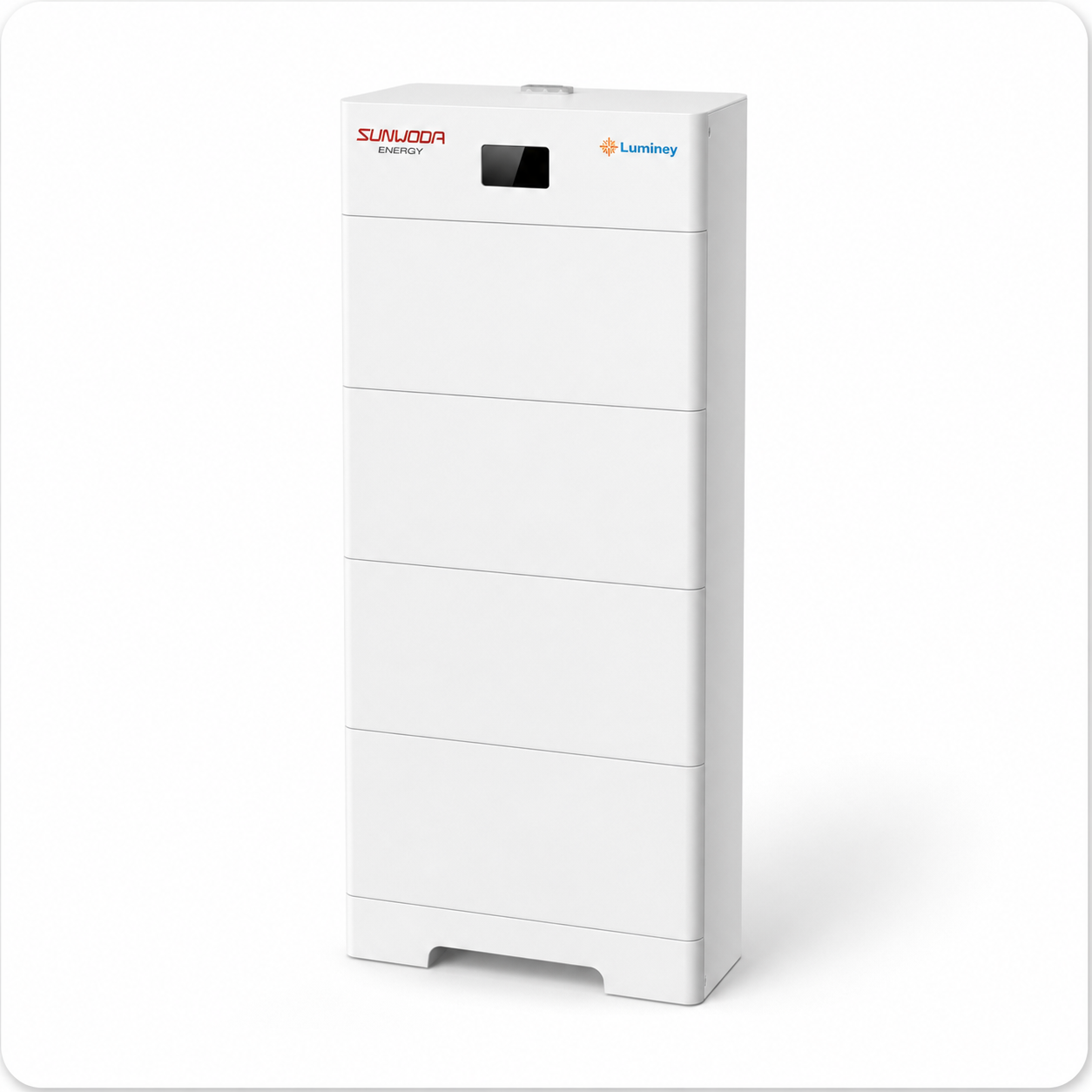
If you are new to solar batteries, terms such as LiFePO4, 48V, 100Ah, kWh and BMS can feel confusing. LiFePO4 stands for lithium iron phosphate, a long-lasting type of lithium battery commonly used for home solar and backup power.
This beginner-friendly guide explains what these terms mean, how much energy a common 48V or 51.2V 100Ah battery stores, which appliances it may run, how long the backup may last, how many solar panels may be needed to recharge it, and what it may cost in Pakistan.
As a simple example, a 51.2V 100Ah battery stores 5.12kWh of energy. After allowing for battery reserve and inverter losses, an 80% planning factor gives approximately 4.1kWh of usable AC energy. That could provide about 8.2 hours at a 500W load, 4.1 hours at 1,000W, or 2 hours at 2,000W. Actual backup time depends on the battery, inverter, temperature and appliances being used.
Lithium Solar Battery in Pakistan Facts at a Glance
Common LiFePO4 battery questions and practical answers
Question
Practical answer
How much energy does it store?
4.8kWh at 48V or 5.12kWh at 51.2V
How many LiFePO4 cells are used?
Usually 16 cells in series for 51.2V nominal
How much backup does it provide?
A 5.12kWh battery may deliver about 4.1kWh of usable household energy after allowing for battery reserve and normal system losses. Actual results depend on the battery and inverter.
What load can it run?
A battery’s Ah rating indicates how much energy it stores. The BMS and inverter ratings determine how much appliance load it can run at one time.
How many panels recharge it?
Energy math often gives 2 to 3 modern 550W to 600W panels, but inverter string requirements can require more
Typical Pakistan price?
Approximately PKR 190,000 to 310,000 in July 2026, before installation
Can batteries be paralleled?
Yes, only when the manufacturer permits it and all units are compatible
A 48V LiFePO4 battery is a rechargeable lithium iron phosphate energy-storage system used with solar, hybrid, off-grid, and backup inverters. The battery stores DC energy while an inverter converts that energy into AC power for household loads.
LiFePO4 is part of the lithium-ion family. It is widely used for stationary storage because the chemistry combines good thermal stability, a flat discharge curve, deep usable capacity, and long cycle life when operated inside the manufacturer's limits.
What Is a LiFePO4 Solar Battery?
A LiFePO4 battery stores electrical energy. Solar panels can charge it during the day. The stored energy can then power lights, fans, refrigerators, televisions and other appliances.
The battery stores direct current, called DC electricity. Most household appliances use alternating current, called AC electricity. An inverter changes the battery’s DC electricity into AC electricity for your home.
LiFePO4 is part of the lithium-ion battery family. It is widely used for solar storage because it can offer:
A lithium battery is not automatically safe just because it uses LiFePO4 cells. It still needs the correct inverter settings, cables, fuses and installation.
Long service life
Good heat stability
More usable energy than many lead-acid batteries
Low maintenance
Fast charging when supported by the battery
Built-in electronic protection
What Do 48V, 51.2V and 100Ah Mean?
The numbers on a battery describe its electrical size.
Voltage
Voltage is similar to water pressure in a pipe. A 48V-class battery is designed to work with a compatible 48V inverter.
Many batteries sold as 48V models are actually rated at 51.2V. This happens because they contain 16 LiFePO4 cells.
Each cell has a standard voltage of about 3.2V:
16 cells × 3.2V = 51.2V
Some older batteries use 15 cells:
15 cells × 3.2V = 48V
The term “48V battery” often describes the battery system class. Always check the exact battery label and datasheet before changing inverter settings.
Amp-hours
The Ah rating shows the battery’s electrical capacity. A 100Ah battery has more capacity than a 50Ah battery at the same voltage.
However, Ah alone does not tell you how much energy the battery stores. You must also know its voltage.
Kilowatt-hours
Kilowatt-hours, written as kWh, tell you how much energy the battery stores.
You can think of kWh as the size of a water tank. A larger tank can supply water for longer. In the same way, a battery with more kWh can usually run appliances for longer.
100Ah Lithium Battery Sizing Guide: Capacity and Solar Math
Use this formula to calculate battery energy:
Battery energy in kWh = voltage × amp-hours ÷ 1,000
This is the battery’s full listed capacity. Your appliances will normally receive less energy.
Some energy is kept as a battery reserve. A small amount is also lost in the inverter, cables and other equipment.
For basic planning, this guide uses an 80% factor:
5.12kWh × 0.80 = 4.10kWh
This means a 5.12kWh battery may provide about 4.1kWh of usable household energy.
The 80% figure is only a planning estimate. Actual results depend on the battery, inverter, temperature, settings and battery condition.
What Can a 48V 100Ah Lithium Battery Run?
Battery capacity and load capacity are not the same thing.
Energy in kWh tells you how long the battery may run appliances.
Power in kW tells you how many appliances it can run at one time.
Imagine the battery as a water tank. The tank size is the stored energy. The pipe size controls how quickly the water can come out.
A battery may store enough energy for several hours but still shut down if too many powerful appliances start at once.
The BMS controls battery output
BMS means battery management system. It is the battery’s built-in safety controller.
The BMS checks:
Battery voltage
Charging current
Discharging current
Cell temperature
Battery balance
Very high or low cell voltage
Short circuits and other faults
The battery’s Ah rating tells you how much it stores. The BMS current rating helps determine how much power it can provide at one time.
Continuous BMS current, approximate DC power at 51.2V, and simple meanings
Continuous BMS current
Approximate DC power at 51.2V
Simple meaning
50A
2.56kW
Suitable for smaller essential loads
80A
4.10kW
Can support a larger group of appliances
100A
5.12kW
Common on some 5.12kWh batteries
150A
7.68kW
Requires equipment designed for the higher current
These are simple DC calculations. The power available at the household socket will be slightly lower because the inverter uses some energy.
The safe limit is always the lowest-rated part of the system. This may be the battery, BMS, inverter, cable, fuse or connector.
How Long Will a 48V 100Ah Battery Last?
Use this simple formula:
Backup time = usable battery energy ÷ appliance load
A 51.2V 100Ah battery provides about 4.1kWh using the 80% planning factor.
Average running loads with estimated backup times and example uses
Average running load
Estimated backup time
Example use
300W
13.7 hours
Lights, fans, router and a refrigerator cycling
500W
8.2 hours
Essential household appliances
750W
5.5 hours
Essentials with a television or computers
1,000W
4.1 hours
A moderate home backup load
1,500W
2.7 hours
Essentials with one larger appliance
2,000W
2.0 hours
A high combined load
3,000W
1.4 hours
A heavy load, if the battery and inverter allow it
These times are estimates. Real appliance use changes during the day.
A refrigerator does not run continuously. An air conditioner changes its power use as the room cools. Pumps and motors may also use extra power when starting.
Load Capacity is Different from Backup Time
Power and energy answer different questions:
Power in kW tells you how much load the battery can run at one moment.
Energy in kWh tells you how long the battery can support that load.
A 5.12kWh battery may have enough energy for several hours of essential loads but still trip if a pump, iron, kettle, or air conditioner pushes current above the BMS limit.
Use this formula for a quick home-backup estimate:
Backup hours = battery voltage x Ah x planning factor / load watts
For a 51.2V 100Ah battery using an 80% planning factor:
51.2 x 100 x 0.80 = 4,096Wh of planned AC energy
These figures are planning estimates. Refrigerator and air-conditioner compressors cycle, motors draw startup current, and real consumption changes throughout the day.
Solar Battery Size Calculator: Free Battery Bank Sizing Tool
Follow these steps to estimate the battery capacity your home needs.
Step 1: List your essential appliances
Write down the appliances that must work during a power cut.
For each appliance, record:
Average power in watts
Number of hours needed
Whether it has a motor or compressor
A plug-in energy meter can give a better result than the number printed on an appliance label.
Step 2: Calculate the required energy
Multiply each appliance’s watts by the number of hours it will run.
Appliance groups with average power, required time, and energy needed
Appliance group
Average power
Required time
Energy needed
Fans and lights
250W
6 hours
1.50kWh
Refrigerator
120W
6 hours
0.72kWh
Internet and laptops
180W
4 hours
0.72kWh
Television
100W
3 hours
0.30kWh
Total
3.24kWh
Step 3: Allow for reserve and system losses
Divide the energy you need by the planning factor:
3.24kWh ÷ 0.80 = 4.05kWh
A 5.12kWh battery gives some extra room for this example.
Step 4: Check which appliances may run together
Add the watts of appliances that may operate at the same time.
Also check appliances with motors or compressors. They may need extra power for a few seconds when starting.
Examples include:
Refrigerators
Water pumps
Air conditioners
Washing machines
Power tools
The inverter and BMS must handle both normal running power and startup power.
A larger battery takes longer to recharge if the charging power stays the same.
A 100Ah battery charging at 50A has a theoretical charging time of about two hours. Real charging usually takes longer because sunlight changes and charging may slow near full capacity.
How many Solar Panels do I need to Charge a 48V 100Ah Battery?
Panel count depends on battery energy, starting state of charge, peak-sun hours, system losses, panel wattage, and the inverter or charge controller's MPPT voltage window.
Use this daily energy formula:
Solar panel power = energy to replace ÷ peak-sun hours ÷ charging efficiency
Suppose you want to replace 5.12kWh in one day. You receive five peak-sun hours and estimate 85% charging efficiency:
5.12kWh ÷ 5 hours ÷ 0.85 = about 1.20kW
This is approximately equal to:
Three 450W panels
Three 550W panels
Two 600W panels
This calculation only estimates the energy needed. It does not design a safe solar panel string.
Many inverters need several panels connected in series before charging can begin. The number of panels must also match the inverter’s voltage and current limits.
Ask a qualified solar designer to check the final panel arrangement.
Calculate the Design Current First
For an inverter, use the low battery voltage rather than nominal voltage:
DC current = AC output watts / low battery voltage / inverter efficiency
Using 44.8V and 90% efficiency for illustration:
Inverter output, estimated full-load DC current, and equal share with two batteries
Inverter output
Estimated full-load DC current
Equal share with two batteries
5kW
124A
62A per battery
6kW
149A
75A per battery
8kW
198A
99A per battery
Current will not split evenly if branch resistance differs. Use equal-length, equal-size positive and negative branch cables to common busbars. Keep batteries at the same model, firmware, capacity, state of charge, and age where the manufacturer requires it.
Get a LiFePO4 Battery Sizing Check from Luminey
Send these details for a more useful battery recommendation:
Inverter brand, exact model, and rated power
Essential appliances and measured watts
Required backup hours
Existing solar array size and panel model
Indoor, outdoor, or partly exposed installation location
City and approximate battery-to-inverter cable distance
How many LiFePO4 cells are needed for a 48V battery?
Most modern 48V-class solar batteries use 16 LiFePO4 cells in series. Each cell is about 3.2V nominal, so 16 x 3.2V equals 51.2V. Some older or specialised systems use 15 cells for 48.0V. The BMS and inverter settings must match the cell count.
How much energy does a 48V 100Ah battery store?
A 48.0V 100Ah battery stores 4.8kWh, while a 51.2V 100Ah battery stores 5.12kWh. Usable AC energy is lower after depth-of-discharge reserve, BMS limits, inverter losses, temperature, and ageing. An 80% planning factor gives about 4.1kWh from a 5.12kWh battery.
What is the load capacity of a 48V 100Ah lithium battery?
Load capacity depends on the BMS current rating and inverter, not 100Ah alone. A 51.2V battery with a 100A continuous BMS can provide about 5.12kW DC at nominal voltage. Actual AC output is lower, and every cable, fuse, connector, and inverter must support the current.
How long will a 48V 100Ah battery last?
Using an 80% planning factor, a 51.2V 100Ah battery provides about 8.2 hours at 500W, 4.1 hours at 1,000W, or 2 hours at 2,000W. Real backup changes with compressor cycling, startup current, inverter efficiency, temperature, battery condition, and the selected reserve.
How many solar panels do I need to charge a 48V 100Ah battery?
Replacing 5.12kWh in five peak-sun hours at 85% efficiency needs about 1.2kW of panels. That equals roughly two 600W panels or three 450W to 550W panels by energy. The inverter's MPPT voltage may require a larger series string, so panel topology needs professional design.
What is the price of 100Ah 48V LiFePO4 battery?
A 48V or 51.2V 100Ah LiFePO4 solar battery costs roughly PKR 190,000 to 310,000 in Pakistan as of 21 July 2026. Installation, DC protection, transport, brand, cell documentation, warranty, IP rating, and inverter compatibility can change the final amount.
Is a 48V battery actually 51.2V?
Many products sold as 48V solar batteries are 51.2V nominal because they use 16 LiFePO4 cells in series. The 48V label identifies the system class. Always use the exact nominal voltage and charging limits from the battery datasheet when configuring an inverter.
Can two 48V 100Ah batteries connect in parallel?
Two compatible batteries can connect in parallel only when the manufacturer permits it. The result is about 51.2V 200Ah and 10.24kWh for two 51.2V units. Use equal branch cables, approved communications, rated busbars, individual branch fuses, and a correctly protected main cable.
What cable size suits a 48V 100Ah battery?
Cable size depends on inverter current, low battery voltage, cable length, temperature, routing, and protection. For short runs, 35mm2, 50mm2, and 70mm2 copper are commonly evaluated around 105A, 150A, and 210A under Victron's stated voltage-drop example. Final sizing requires the equipment manual and local rules.
Does a 100Ah battery run a 5kW inverter?
A 51.2V 100Ah battery can support a 5kW inverter only if its BMS, terminals, cables, fuses, and discharge specification allow the required current. A 5kW inverter can draw about 124A near 44.8V at 90% efficiency, which exceeds many 100A battery ratings.
What BMS size does a 48V battery need?
The BMS must match the exact cell count and required continuous, peak, and charging currents. A 16S battery needs a 16S-compatible BMS. Select current from the inverter's worst-case DC demand and battery cell limits, then include manufacturer-defined margins and temperature derating.
Can LiFePO4 batteries run an air conditioner?
A LiFePO4 battery can run an inverter air conditioner when the BMS and inverter support its continuous and startup power. Runtime depends on the AC's measured average consumption and other loads. A 5.12kWh battery may provide only a few hours under a substantial combined load.
Can a lead-acid charger charge LiFePO4?
Use a charger or inverter profile explicitly approved for the LiFePO4 battery. Lead-acid equalisation, desulphation, and unsuitable float settings can trigger protection or damage the battery. Follow the battery manufacturer's charging voltage, current, temperature, and communication instructions.
Is LiFePO4 safer than other lithium batteries?
LiFePO4 chemistry is valued for thermal stability in stationary storage, but no high-energy battery is risk-free. Safe operation still requires a competent BMS, correct fusing, suitable cables, protected installation, approved charging settings, secure terminals, and compliance with manufacturer instructions and local electrical requirements.
How long does a LiFePO4 solar battery last?
Service life depends on temperature, depth of discharge, charge rate, time at high state of charge, and cell quality. Some 5.12kWh products specify at least 6,000 cycles under controlled conditions. Compare written warranty years, energy throughput, cycle limits, and retained-capacity terms instead of cycle count alone.

.png)