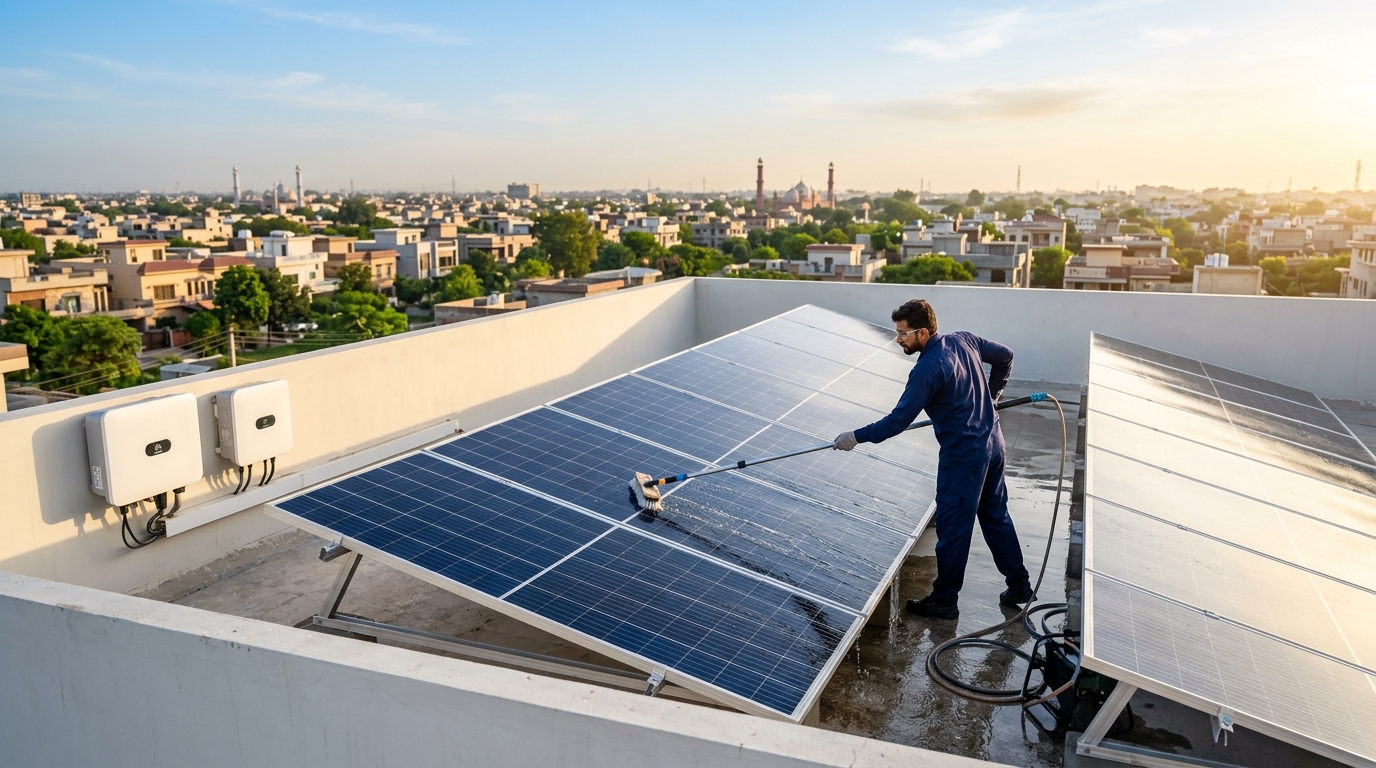
Solar panel cleaning services are one of the cheapest ways to protect the return on a solar system in Pakistan. Dust from construction, traffic, crop burning and desert winds settles on panels within days, and a dirty array can quietly lose a large share of its output. This guide covers how often to clean in each season and city, what cleaning costs in 2026 for homes, businesses and factories, and how to clean without damaging panels or voiding warranties.
How Often and How Much Should You Opt for Solar Panel Cleaning Services?
Homes: clean every 2–4 weeks in the dry season (April–June and October–February). In the monsoon, every 6–8 weeks is usually enough.
Commercial rooftops: clean every 2–3 weeks, and after every dust storm.
Industrial and dusty sites such as cement, textile, steel or roadside plants: clean weekly or fortnightly, or fit an automatic cleaning system.
Typical 2026 cost: roughly Rs 150–300 per panel, or Rs 250–400 per kW per visit, for homes in Lahore. Large commercial and industrial jobs are cheaper per kW, and monthly plans are discounted.
Safety: use soft brushes and clean or deionised water, clean early in the morning, and never use pressure washers, detergents or harsh scrubbing pads.
These figures are indicative market ranges from Pakistani service providers. Always ask for a written quote.
Solar Panel Cleaning Services in Pakistan - Why It's Essential for Efficiency
Pakistan has some of the best sunshine in the region, with about 5–5.5 peak sun hours a day according to the Global Solar Atlas. But it also has some of the dustiest air. Research on soiling, including studies from NREL, shows that dust can cut output by 5–25% depending on location, panel tilt and how long it has been since rain. In Lahore, Multan and Karachi, bird droppings, smog residue and fine dust make the problem worse, and even a partly covered cell can trigger bypass diodes and hot spots.
Under NEPRA's 2026 net billing rules, every unit you generate and use yourself saves your full tariff. Exported units earn far less. As we explain in net metering vs gross metering, lost generation now costs you more than it did under net metering. That makes regular cleaning even more valuable.
What does dust cost you?
Take a 10kW home system that generates about 1,300 units a month. A 15% soiling loss wastes around 195 units. At a tariff of about Rs 60 per unit, that is roughly Rs 11,700 a month, far more than a cleaning visit that costs Rs 2,500–4,000.
Solar Panel Cleaning Frequency Guide for Pakistan
The right frequency depends on local dust, rainfall, panel tilt and what is nearby. Use this as a starting point, then adjust it by checking your inverter app for drops in output.
Solar panel cleaning frequency by location and season in Pakistan
Location / site
Dry season (Oct–Jun)
Monsoon (Jul–Sep)
Notes
Lahore, Faisalabad, Gujranwala
Every 2–3 weeks
Every 6–8 weeks
Smog residue in winter needs a wet clean
Karachi, Hyderabad
Every 2–3 weeks
Every 4–6 weeks
Salt haze near the coast; rinse to prevent film
Multan, Bahawalpur, Sukkur
Every 1–2 weeks
Every 4 weeks
Desert dust storms; clean after each one
Islamabad, Rawalpindi, Peshawar
Every 3–4 weeks
Every 8 weeks
Pollen in spring
Near construction, roads or factories
Weekly
Every 2–3 weeks
Consider an automatic system
Farms and tube-well solar
Every 1–2 weeks
Every 4 weeks
Harvest and crop-burning seasons are the worst
How often should solar panels be washed in Lahore?
For most Lahore homes, every 2–3 weeks from October to June is the sweet spot. In winter, smog leaves an oily film that a dry brush won't lift, so a gentle wet wash is needed. During the monsoon, rain does part of the job, but muddy streaks are often left along the lower edge of each panel. A light rinse every 6–8 weeks handles those.
How often should solar panels be cleaned and serviced?
Cleaning and servicing are different jobs:
Cleaning: every 2–8 weeks, depending on the table above.
Visual inspection: monthly. Look for cracks, hot spots, loose clamps and bird nests under the panels.
Electrical service: every 6–12 months. This means checking DC connectors, torquing terminals, testing SPDs and earthing, and cleaning the inverter's fans and filters.
Thermal imaging and IV-curve testing: once a year for commercial and industrial plants.
Your inverter monitoring app is the best early warning. A steady fall of 5% or more on clear days usually means it is time to clean.
What Is the 20% Rule for Solar Panels?
The "20% rule" is an informal rule of thumb, used in two ways:
Sizing: design your system about 20% larger than your calculated need, so that dust, heat and ageing losses don't leave you short.
Cleaning trigger: if output on a clear day falls about 20% below the system's normal output for that season, clean or inspect the system straight away. Dust, shading or a fault is likely.
Under net billing, avoid oversizing well beyond 20% just to export, because exported units earn a lower buyback rate.
Solar Panel Cleaning Cost in Lahore 2026: Per Visit & Plans
Prices vary by roof access, floor height, the number of panels, water availability and how dirty the panels are. Note that the prices mentioned below are indicative only.
Solar panel cleaning pricing by system size in Pakistan
System
One-time visit
Monthly plan (per visit)
Typical frequency
3–5 kW home (6–9 panels)
Rs 1,500–2,500
Rs 1,200–2,000
2–4 weeks
10 kW home (17–18 panels)
Rs 2,500–4,000
Rs 2,000–3,200
2–4 weeks
20–50 kW commercial
Rs 180–300 per kW
Rs 150–250 per kW
2–3 weeks
100 kW+ industrial
Rs 100–200 per kW
Custom O&M contract
1–2 weeks
Solar panel cleaning service price in Pakistan: what affects it?
Access: a double-storey roof, raised structures or a steep tilt add labour and safety equipment.
Water: sites without water on the roof need water brought in or a tanker.
Condition: bird droppings, cement dust or long neglect need more time.
Extras: an inspection report, inverter cleaning or thermal imaging cost more.
Location: rates in Karachi and Islamabad are often slightly higher than in Lahore.
How much does a solar panel cleaning system cost?
A solar panel cleaning system in Pakistan means equipment that automates or speeds up the job:
Solar panel cleaning pricing by system size in Pakistan
System
One-time visit
Monthly plan (per visit)
Typical frequency
3–5 kW home (6–9 panels)
Rs 1,500–2,500
Rs 1,200–2,000
2–4 weeks
10 kW home (17–18 panels)
Rs 2,500–4,000
Rs 2,000–3,200
2–4 weeks
20–50 kW commercial
Rs 180–300 per kW
Rs 150–250 per kW
2–3 weeks
100 kW+ industrial
Rs 100–200 per kW
Custom O&M contract
1–2 weeks
Automatic systems pay back fastest on large, dusty sites where labour, water and access are the main costs. For a single home, a good manual kit plus a professional wash every one to two months is usually enough.
Solar Panel Cleaning Frequency and Maintenance Cost for Homes, Businesses and Industry
Residential
A homeowner with a 5–10 kW system should budget about Rs 25,000–50,000 a year for cleaning and a yearly electrical check. Many owners do a quick rinse themselves and book a professional wash every month or two.
Commercial
Offices, schools, hospitals, malls and warehouses use most of their power during the day, so dirty panels directly raise the grid bill. Ask for a fixed-frequency plan with a before-and-after generation report, a response time for faults and certified technicians who work at height.
Industrial
Factories and large plants should use a written O&M contract that covers cleaning frequency, water quality, performance ratio targets, thermal scans and safety compliance. On high-dust sites such as cement, steel and textile plants, weekly cleaning or robotic systems often pay back within months. Coordinate cleaning with production shutdowns and with the site's permit-to-work rules.
Solar Panel Cleaning Guide 2026: How to Clean Safely
Follow these steps whether you do it yourself or supervise a service:
Clean early in the morning or late in the evening. Cold water on hot glass at midday can cause thermal shock and leaves water spots.
Switch off the system. Turn off the inverter and the DC isolator before any wet cleaning.
Stay safe at height. Use a harness on roofs without parapets, keep off wet sheet roofs, and work from walkways. Never stand on the panels.
Dry-brush first. Use a soft, non-abrasive brush to remove loose dust.
Rinse at low pressure. Use clean water, ideally soft or deionised. Hard tube-well water leaves mineral scale.
Wipe gently. Use a squeegee or microfibre cloth, and a mild neutral cleaner only if the manufacturer allows it.Check and record. Look for cracks, loose cables and nests, then compare generation the next day.
What to avoid
High-pressure washers, which can break seals and void the warranty.
Detergents, acids, solvents or anything abrasive, which damage the anti-reflective coating.
Walking on panels or leaning ladders against them.
Cleaning damaged panels or exposed wiring yourself. Call a technician.
Check your panel maker's cleaning instructions, because warranty terms usually specify approved methods.
Solar Panel Washing Service Near Me: How to Choose One
When you search for a "solar panel washing service near me", compare providers on these points:
Trained staff with safety equipment and insurance.
Soft brushes and filtered or deionised water, not pressure washers.
A clear solar panel cleaning rate per panel or per kW, and a written quote.
Before-and-after photos or a generation report.
An inspection of cables, structures and the inverter included in the visit.
Reviews from customers in your area, and a quick response after dust storms.
How to Clean Solar Panels DIY?
You can clean the panels on most single-storey homes yourself, as long as you can reach the roof safely. It takes about 30–45 minutes for a 5–10 kW system. You'll need:
A soft brush on a telescopic pole
A garden hose with a gentle spray nozzle, not a pressure washer
A bucket of clean water, ideally soft, filtered or deionised
A rubber squeegee or microfibre cloth
Rubber gloves and non-slip shoes, plus a safety harness if the roof has no parapet
Step by step:
Pick the right time. Clean early in the morning or after sunset, when the glass is cool. Cold water on hot panels at midday can stress the glass and leaves spots.
Shut the system down. Switch off the inverter, then the DC isolator.
Dry-brush first. Sweep loose dust and leaves from the top edge downward.
Rinse gently. Wet the panels at low pressure to soften dirt, bird droppings and smog film.
Scrub lightly. Use the soft brush with plain water. For stubborn spots, add a few drops of mild, pH-neutral soap to the bucket.
Rinse and dry. Rinse off any soap and squeegee the glass so hard water doesn't leave mineral marks.
Inspect and restart. Look for cracks, loose cables or nests under the panels, then switch the system back on. Compare the next day's output in your inverter app.
Don't: stand on the panels, use pressure washers, abrasive pads, detergent powders or acids, or clean panels that are cracked or have exposed wiring. Call a technician for any of those.
Frequently Asked Questions
Do solar panels need cleaning?
Yes, especially in Pakistan. Dust, smog residue, bird droppings, pollen and construction dust build up quickly, and rain seldom washes panels fully clean. It often leaves mud streaks along the bottom edge. Most homes need a clean every 2–4 weeks in the dry season and every 6–8 weeks during the monsoon. Industrial and roadside sites may need weekly cleaning.
How often do solar panels need to be cleaned?
In most of Pakistan, every 2–4 weeks in the dry months and every 6–8 weeks in the monsoon. Dusty, industrial or desert sites may need weekly cleaning.
What is the best way to clean solar panels?
Dry-brush with a soft brush, rinse at low pressure with clean or deionised water, scrub gently only where needed, then squeegee dry. Do it in the cool early morning with the system switched off. For high, sloped or large commercial and industrial roofs, a professional service with safety equipment is the better choice.
What are the solar panel cleaning chemicals?
Usually you don't need any. Plain water, ideally deionised or softened, is the safest option and is what most manufacturers recommend. For greasy smog film or bird droppings:
Safe: a few drops of mild, pH-neutral, biodegradable soap in a bucket of water, or a cleaner made specifically for solar panels that the panel maker approves.
Sometimes used: a heavily diluted isopropyl alcohol solution, for spot-cleaning oily marks only.
Avoid: detergent powders, bleach, ammonia-based glass cleaners, acids, solvents, petrol or kerosene, and anything abrasive. These can damage the anti-reflective coating and the frame seals, and they may void your warranty.
Always check your panel manufacturer's cleaning guidelines before using any product.
How much does it cost to clean solar panels?
Home cleaning usually costs about Rs 150–300 per panel, or Rs 250–400 per kW, per visit. A 10 kW home typically pays Rs 2,500–4,000. Commercial and industrial sites pay less per kW, especially on monthly contracts.
What is the solar panel cleaning rate for large commercial systems?
Indicative rates are Rs 100–300 per kW per visit, depending on size, access and frequency. Annual O&M contracts often bundle cleaning with inspections.
Does cleaning solar panels make a difference?
Yes. Depending on how dusty the site is and how long it has been since the last clean, dirty panels can lose about 5–25% of their output. For a 10 kW home generating about 1,300 units a month, a 15% loss is roughly 195 units, or around Rs 11,700 a month at Rs 60 per unit. That is far more than the cost of a cleaning. Under NEPRA's 2026 net billing rules, every unit you generate and use yourself saves your full tariff, so keeping panels clean pays off even more. The effect is easy to check: compare output in your inverter app on a clear day before and after cleaning.
Does rain clean solar panels?
Partly. Heavy rain removes loose dust but often leaves mud streaks, smog film and bird droppings, so panels still need occasional washing.
Can I clean solar panels myself?
Yes, if the roof is safe to reach. Use a soft brush and clean water, and switch off the system first. For high or sloped roofs, hire a professional service.
Is a solar panel cleaning system worth it for a home?
A sprinkler line or manual kit can be worth it where water is easy to reach. Robotic systems usually only pay off on large commercial or industrial arrays.
Does cleaning void my solar panel warranty?
No, as long as you follow the manufacturer's approved method. Pressure washing, abrasive tools or harsh chemicals can void it.